Why is custom joinery so expensive when an online wardrobe guide says $1,000 to $5,000 and a joiner quotes $9,000 for one wall? Because the two prices can describe different products, different sites and different responsibilities. Neither number is automatically dishonest. The useful task is to discover what each one buys before you accept the cheapest.
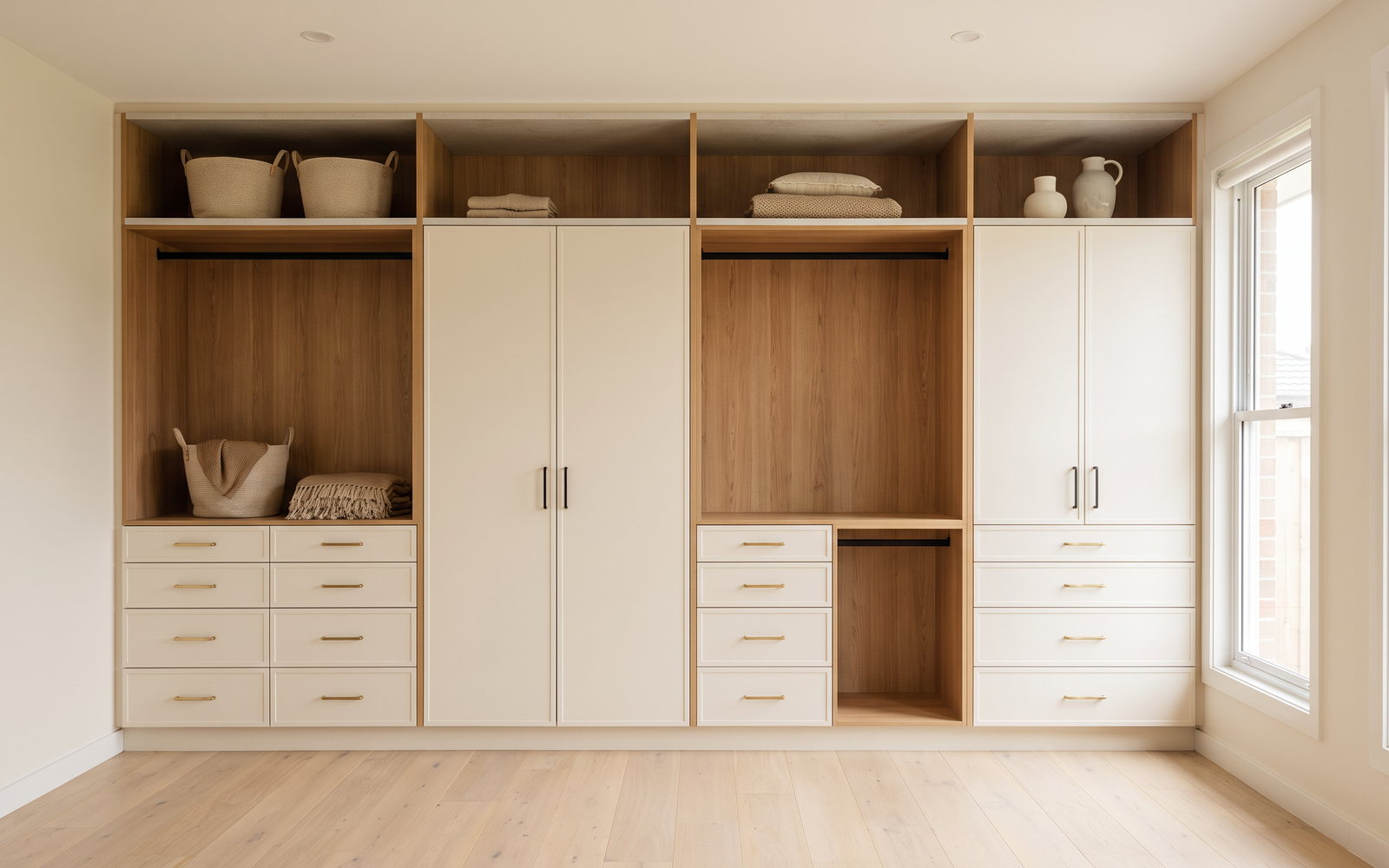
A built-in wardrobe that arrives as basic components is not the same job as a measured wall of cabinetry with scribed fillers, named drawer hardware, finished end panels, delivery up stairs, installation, touch-up and a written defects path. A good quote makes those differences visible. A poor quote hides them until the budget is already committed.
The short answer
A price gap is usually created by scope, not by a mysterious “custom” tax. Start by normalising the product: same wall length, same height, same internal layout, same finish, same hardware, same installation and same GST basis. Then check who carries site risk, variations and warranty responsibility.
| Item | Basic published price context | Site-specific custom context | Why the gap can be real |
|---|---|---|---|
| Wardrobe | $1,000–$5,000 | built-ins $7,000–$15,000 plus | Size, fit, finish, hardware and installation vary |
| Walk-in robe | market scope varies | $18,000–$40,000 plus | More runs, corners, drawers and detailed interiors |
| Laminate cabinetry | $800–$1,400 per linear metre | measured and installed scope required | Cabinet length does not capture drawers and site work |
| Two-pack cabinetry | $1,800–$3,000 per linear metre | measured and installed scope required | Coating, profiling and repair standards add labour |
The two numbers, side by side
A lower marketplace figure is useful as a signal that wardrobes come in a wide range. It is not a design drawing, a site measure or a promise that a particular awkward wall can be fitted for that number. A custom quote may feel high because it puts all the missing work onto one document.
| Scope line | $1,000-style entry point | $9,000-style custom wall |
|---|---|---|
| Measure and design | Basic dimensions or buyer-supplied | Site measure, layout and approvals |
| Cabinet size | Standard module or small run | Wall-to-wall and floor-to-ceiling fit |
| Materials | Generic board and finish | Named board, finish and edging |
| Hardware | Basic hanging and shelves | Drawers, soft-close hinges and accessories |
| Site conditions | Assumed square and accessible | Scribing, protection and access planned |
| Delivery and installation | Often separate or limited | Included if stated in the written scope |
| Responsibility | Product seller or fragmented trades | One party responsible for defined joinery works |
This is not an attack on aggregators or product sellers. Their ranges answer a different early-stage question: what might a category cost? The custom quote answers: what will this exact room cost if a workshop is responsible for a finished result?
What an aggregator price range actually measures
Price guides have to cover enormous variation. A wardrobe may be a short freestanding unit, a basic built-in with shelves, a supply-only system, a painted full-height room, or a walk-in robe with drawers and lighting coordination. The published range makes room for that variety. It is a helpful starting point, not a scope of works.
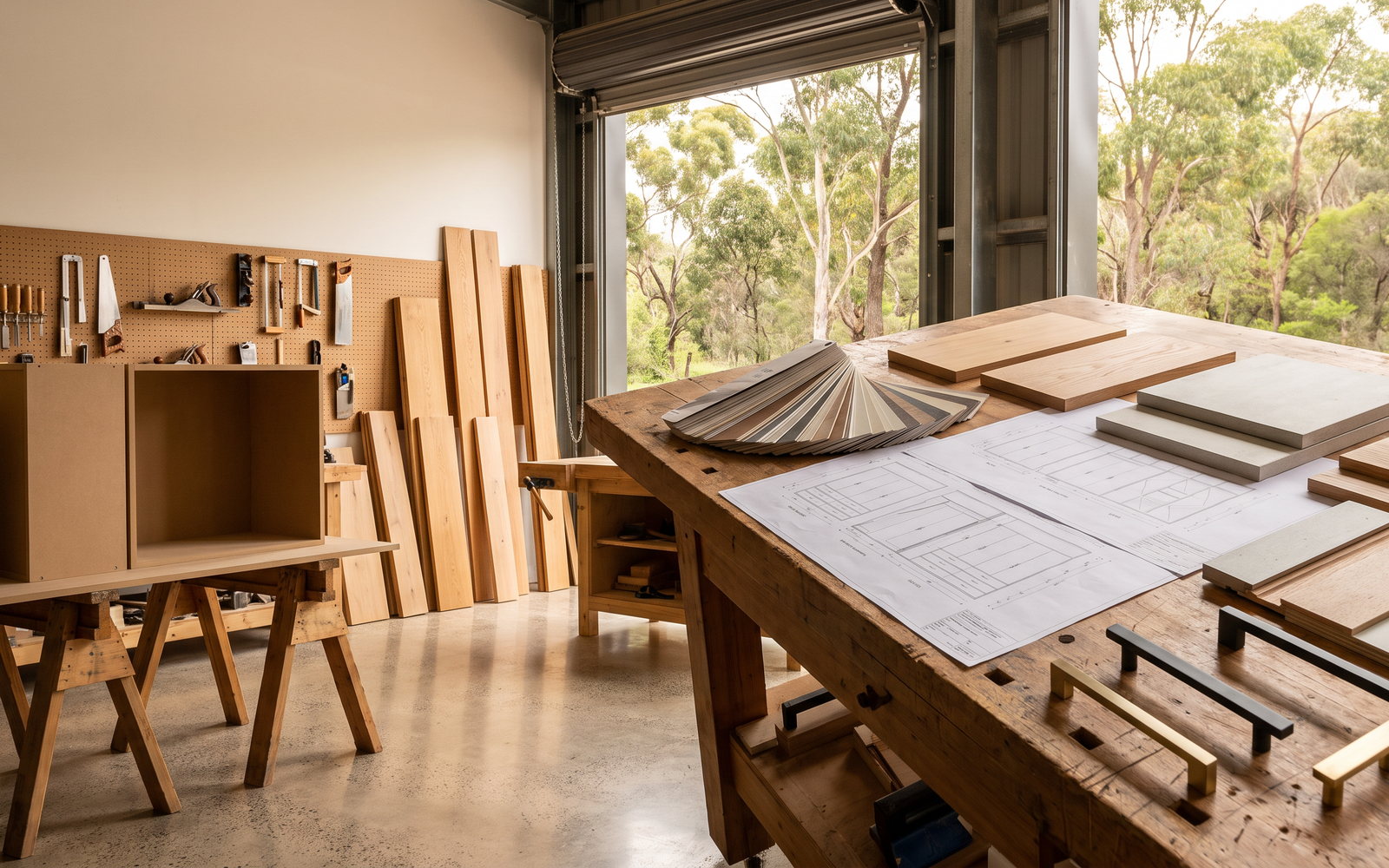
If you want a meaningful comparison, use the same set of drawings or at least a simple brief. State the overall wall dimensions, ceiling height, doors, shelves, drawers, hanging lengths, finish, handles, existing flooring, electrical impacts, access and whether removal is required. Then ask each contractor to list what is missing from that brief.
Nine things that change a joinery price by thousands
The change is often made of several modest decisions, not one extravagant selection.
| Price driver | Why it shifts the price | Typical impact |
|---|---|---|
| Overall size | More board, edging, doors and installation time | Direct material and labour growth |
| Drawer quantity | Drawer boxes and runners are hardware-intensive | Can outweigh a simple shelf run |
| Finish | Laminate, polyurethane and veneer need different processes | Per-linear-metre bands differ materially |
| Internal fittings | Pull-outs, shoe storage and integrated accessories add parts | Scope-dependent |
| End panels and fillers | Bespoke fit needs finished edges and scribing | Essential on visible or uneven walls |
| Site access | Stairs, parking, lift rules and protection add handling | Site-dependent |
| Demolition and making good | Existing work can hide services and damage risk | Separate trade or allowance |
| Installation responsibility | A delivered cabinet is not an installed cabinet | Clarify before comparison |
| Design changes | Late changes create new drawings and materials | Use written variations |
The hardware line is a good example. A Blum LEGRABOX drawer system is advertised from $233 including GST per box, while hinges are listed from about $14. A run with several premium drawers can carry a meaningful hardware cost before the cabinet, finish and labour are counted.
GST, and the quotes that quietly exclude it
For consumer prices, the ACCC single-price rule means the displayed price should be a total including GST, as explained by business.gov.au. Commercial proposals may use an ex-GST presentation by convention, but the basis must be obvious. A $9,000 including-GST quote is not comparable with a $9,000 ex-GST quote.
Write “including GST” beside every total when you compare. If a proposal is an estimate, record the contingency and the items still to be selected. This is basic administration, but it prevents the most common false saving in renovation quotes.
STEEPWOOD CUSTOM JOINERY — A price is only useful when the scope beside it is clear. Get a free measure and quote with named materials, hardware and exclusions.
Allowances, exclusions and the word “supply only”
An allowance is not a problem when it is described. A benchtop allowance can be sensible before a final template. An appliance panel allowance can be sensible before the appliance model is ordered. The document must say the allowance value, GST basis, supplier assumption, what happens if it changes and who approves the variation.
Exclusions need the same treatment. “Supply only” usually means no site installation, but it can also mean no measure, no delivery, no trimming, no assembly or no responsibility for service interfaces. Never infer the meaning. Ask the contractor to write it in plain language.
Hardware, and the cheapest place to hide a saving
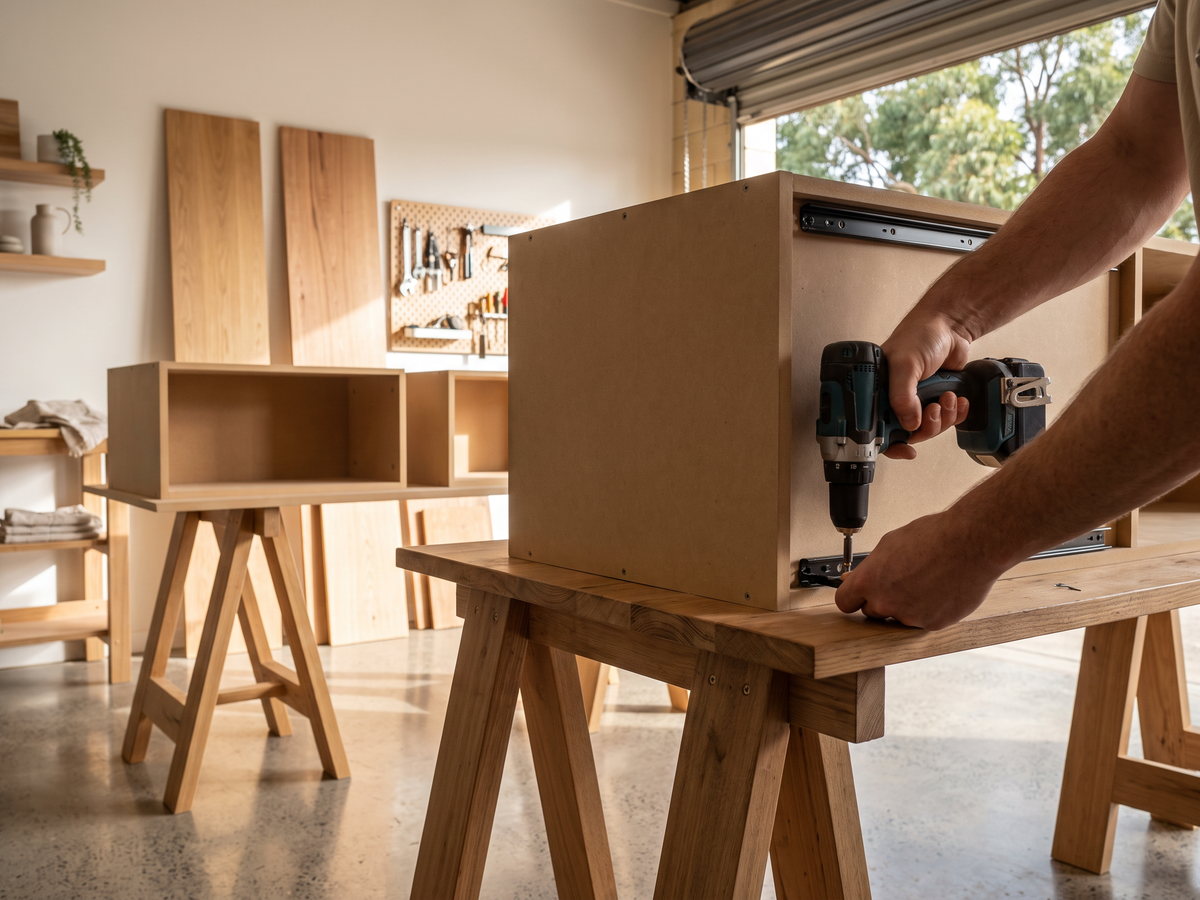
Hardware is easy to conceal because a drawer may look identical on handover. The difference appears after years of use. Ask for the brand and system, not the phrase “premium European hardware”. Brands such as Blum, Hettich and Häfele have identifiable products; that gives the buyer something concrete to compare.
A lower-cost hinge may be appropriate in a light-use cupboard. A heavily used drawer, pull-out pantry or tall door deserves a specified system and correct installation. This is not an instruction to buy the most expensive hardware everywhere. It is an instruction to specify the load and use, then compare like with like.
Site conditions: out-of-square walls, old floors, strata access
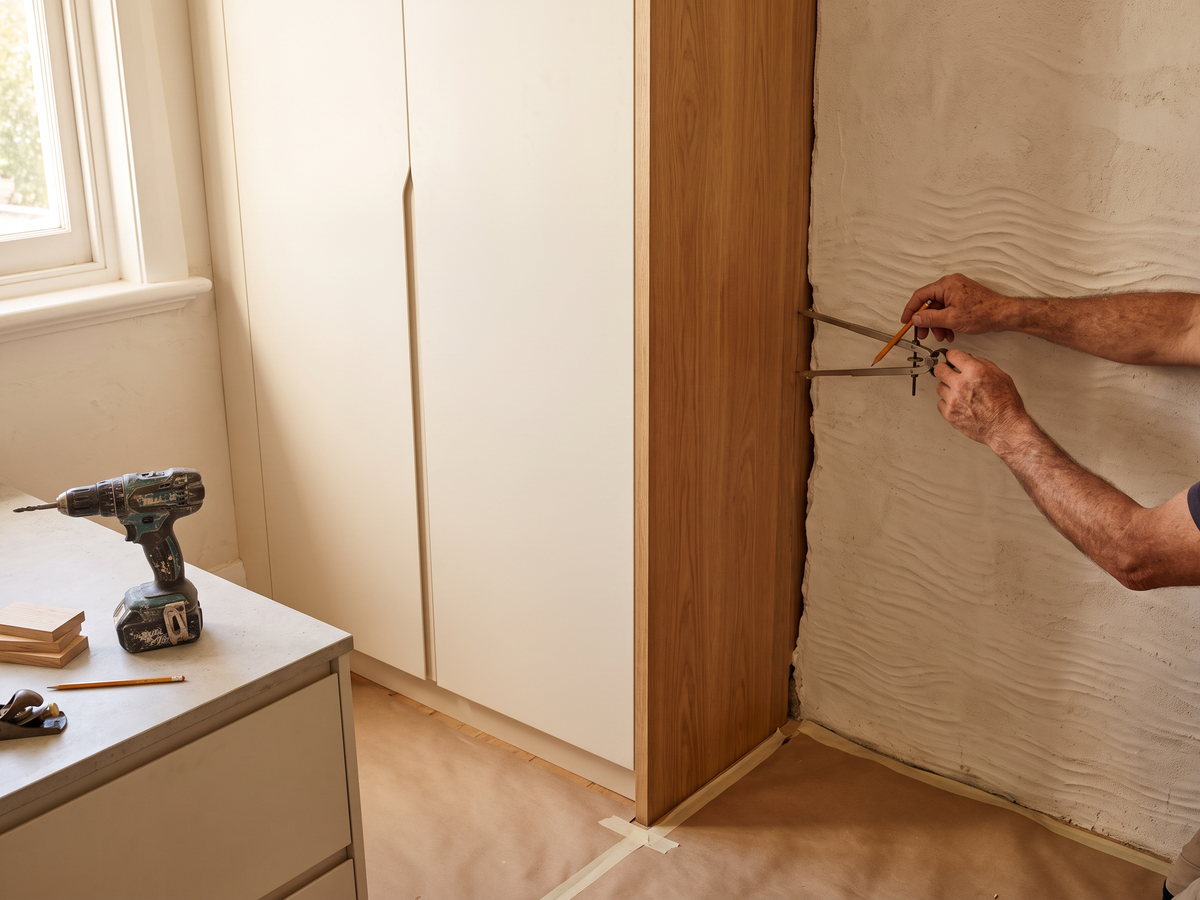
Joinery is built square; houses rarely are. Older walls can lean, floors can drop, bulkheads can conceal services and alcoves can be inconsistent from one end to the other. The workshop resolves that with a final measure, scribes, fillers, packers and installation time. That is work, not an optional luxury.
Apartments add another layer: lift booking, loading zones, building hours, protection requirements and rubbish routes. A quote that includes those controls can appear dearer than a product price delivered to the kerb. It may nevertheless be the only number that can complete the job legally and safely in that building.
Insurance, licence and warranty as price components
For NSW residential building work above $5,000 including GST, verify that the contractor holds the appropriate licence. A written contract is required above the relevant threshold, and HBCF applies at the $20,000 including-GST threshold, with the certificate before deposit or payment. Check the actual contract rather than assuming every cabinet job has the same insurance position.
Statutory warranties run six years for major defects and two years for other defects. A legitimate contractor has to allow for the cost of doing accountable work. Use the consumer rights information as part of your pre-deposit check, not after a dispute starts.
A quote comparison worksheet
Put the same headings across every proposal. Do not merely circle the lowest total.
| Check | Quote A | Quote B | Quote C |
|---|---|---|---|
| GST-inclusive contract total stated | |||
| Drawings or dimensions attached | |||
| Board, finish and edge detail named | |||
| Hardware brand and model named | |||
| Delivery and installation included | |||
| Demolition and disposal identified | |||
| Benchtop and appliance interfaces stated | |||
| Licence details and contract terms supplied | |||
| Allowances and exclusions costed | |||
| Variations process stated |
This worksheet is why a quote from a workshop can be longer than a two-line estimate. The paperwork is part of the product: it defines what the client is entitled to receive.
How to read three quotes for one wardrobe wall
First, remove the totals from view. Compare the proposed geometry and drawings. Are the doors the same height? Does one quote include full-height fillers, while another leaves a gap? Are drawers included, and are they soft-close? Is the internal layout the same? Does the proposal finish against the skirting and ceiling in the same way?
Second, add the totals back with GST normalised. Ask each contractor to reprice the same material and hardware specification if needed. You may find the “expensive” quote has a better scope; you may also find a higher quote is adding features you do not need. Both outcomes are valuable because they create a genuine decision.
For wardrobe-specific choices, see the wardrobe cost guide. For the separate decision between a modular product and a workshop-made kitchen, the flat-pack versus custom kitchen guide is the right comparison. Do not use one to answer the other.
The details that make a custom quote valuable
A custom quote should contain decisions, not adjectives. “Premium finish”, “quality board” and “soft-close hardware” sound reassuring but cannot be checked. Replace them with the panel product, visible finish, edge treatment, door profile, handle or handleless system, hinge or runner brand, drawer quantity, internal accessories and the exact extent of installation.
The same principle applies to the room around the cabinetry. Does the quote include a temporary measure after demolition? Is there a tolerance for an old wall? Who removes skirting, patches a wall, disconnects appliances or reconnects a service? Are floor protection, stair carries and parking included? A workshop can provide a very good price for manufacturing and still not be carrying those site tasks. That is fine only if the division is written down.
There is also a material distinction between a cabinet run and a furniture-quality fitted wall. A simple run may use square ends and a straightforward door system. A fitted wall can require scribes on both sides, a shaped ceiling filler, cut-outs around a bulkhead, service panels, a return panel to cover a visible side and carefully sequenced installation. Each item is a small line. Together they explain a large gap.
A buyer can choose to simplify the brief. Fewer drawers, a standard laminate, square door fronts, less internal organisation and a shorter run can be sensible cost controls. The mistake is believing those choices are already included in a quote when no specification says so. Ask the joiner to price a “good, better, best” schedule using the same site and layout. It makes the trade-offs visible without forcing the project into a false bargain.
What a fair comparison meeting sounds like
A fair comparison meeting is practical. The client says, “I have another proposal with laminate doors, three drawers and installation included. Can you price the same scope or tell me what changes?” The joiner explains the difference: perhaps their figure includes a two-pack finish, a different drawer system, removal, or finished side panels. The client then chooses, rather than guessing.
Be cautious with the phrase “same as the picture”. A photograph does not show substrate, thickness, edge detail, internal hardware, appliance clearance, floor level, wall condition, structural support or delivery path. Use images to explain the design intent, then turn that intent into a measurable schedule. This is slower than comparing an online price, but it is much faster than resolving a dispute after manufacture has started.
One final control is a sign-off point before materials are ordered. Read the drawings, door swing, internal layout, hardware and finish sample together. If anything has changed, record it as a variation before manufacture. That protects the client from assumptions and the workshop from building to an old version.
It is a simple checkpoint that prevents expensive disappointment.
Keep the approved version with the contract documents.
Quote variance across NSW
A joinery job is affected by geography when it changes access, travel, delivery, parking, strata controls or housing condition. The region does not make a cabinet intrinsically more expensive. The project conditions do.
| NSW region | Local factor that can legitimately shift price |
|---|---|
| Newcastle | Older inner-city walls, hills and varied site access |
| Lake Macquarie | Travel around the lake and coastal exposure choices |
| Central Coast | Coastal properties and holiday-home access windows |
| Maitland | New-estate handover and builder coordination |
| Hunter Valley | Rural delivery distance and access planning |
| Sydney CBD | Dock bookings, lifts and restricted installation hours |
| Inner Sydney | Parking, stairs and apartment strata requirements |
| Wollongong | Coastal exposure and inter-regional programme |
SteepWood is Pavit Cabinetry Pty Ltd trading as SteepWood, NSW Carpentry Contractor Licence 489553C (verify a contractor licence through Service NSW), ABN 52 697 313 269, and NSW requires a licence for residential building work above $5,000 including GST. Our cabinetmaker wage and charge-out guide explains why a labour figure is not the total project cost; our questions to ask a custom joiner help test the rest of the proposal.
FAQ
Why is custom joinery so expensive?
Custom joinery costs more because the price includes a measured design, specified materials, manufacture, hardware, delivery, installation and responsibility for the fit. Complex sites, painted finishes, drawer hardware and tight access can each change the total. Compare written scopes line by line to judge value.
Why did hipages say $1,000 and my joiner said $9,000?
A published marketplace range and a site-specific custom quote can measure very different things. The lower figure may describe a basic, small or supply-only job, while the higher quote can include a full measured wall, named hardware, installation and site work. Ask both what is included before deciding either number is wrong.
Are quotes usually including GST?
Consumer prices should be presented as a single total including GST, while some commercial quotations state an ex-GST basis. Ask the contractor to identify the GST basis and total contract price in writing. Do not compare an ex-GST figure with an including-GST figure as though they are the same.
What should a written joinery quote contain?
A written joinery quote should identify the scope, dimensions or drawings, materials, finishes, hardware, installation, exclusions, GST basis, payment terms, timing assumptions and variation process. It should also give the contractor’s licence details where required. The document needs enough detail for two proposals to be compared fairly.
Is the cheapest quote ever the right one?
The cheapest quote can be right when it genuinely covers the same specified work with a viable contractor. It is risky when it is vague, omits materials or installation, excludes GST without saying so, or cannot identify licence and warranty details. Compare scope and risk before comparing totals.
How many quotes should I get?
Two or three comparable written quotes are usually enough if every contractor receives the same brief and answers the same questions. More prices do not help when every scope is different. Spend the effort making the information comparable, then clarify differences before paying a deposit.
STEEPWOOD CUSTOM JOINERY — Bring the three quotes to the same written scope before you decide. Get a free measure and quote.