A cabinet maker hourly rate in NSW is not the same thing as the number on a client invoice. Published Joinery and Building Trades Award base rates sit at about $25.74 to $27.97 an hour, while specialist carpentry and joinery charge-out can be more than $120 an hour. The gap is real, and a competent workshop should be able to explain it without hiding behind “overheads”.
The person sanding a door may earn a wage. The workshop charging for that door must pay for the person, the time when nobody can invoice, the machine that cuts it, the premises that house the machine, insurance, administration and the obligation to return if something is wrong. That is not a defence of every high quote. It is the starting point for comparing one properly.
The short answer
Do not divide a fixed joinery quote by a guessed number of hours and decide a workshop is overpriced. Instead, ask which hours are included, whether the price includes GST, what materials and hardware are specified, who takes responsibility for installation, and what happens if the site does not match the drawings.
| Number | What it represents | What it does not represent |
|---|---|---|
| about $25.74–$27.97/hour | Published award base rates for cited joinery classifications | A client-facing price for a complete project |
| about $63/hour low Sydney tier | Published Sydney carpentry price benchmark | A full custom-joinery specification |
| about $98/hour typical Sydney tier | A market comparison for carpentry work | A universal NSW rate |
| about $150/hour high Sydney tier | Complex or specialist Sydney work benchmark | The wage paid to a cabinetmaker |
| more than $120/hour | Published specialist carpentry and joinery guide figure | Proof that every specialist quote is fair |
Two numbers people confuse
A wage is employment pay. A charge-out rate is the price a business needs to invoice for a defined productive hour. They are related, but they are not meant to match.
A wage pays the employee. A charge-out rate must recover the employer's cost of employing that person, the cost of having a workshop available, and the work nobody sees: estimating, ordering, machine setup, programming, loading, protecting a customer's home, resolving a variation and returning for a final adjustment. The customer is not buying a timesheet; they are buying a finished installation that works.
That distinction matters most on custom kitchen joinery. Cabinetry is reported as roughly thirty-five to forty-five per cent of a kitchen total, so a vague labour assumption can distort the whole renovation budget.
What the award actually pays
The relevant award is a wage framework. Published summaries of the Joinery and Building Trades Award list base rates around the $25.74 to $27.97 per-hour range, with the applicable classification, allowances, overtime and current pay guide determining what an individual employee receives. For current employment decisions, a business and worker should use the official Fair Work material or professional advice rather than a blog summary.
The useful consumer lesson is modest: award pay is a floor for employment, not a licence to assume a contractor's invoice should be the same. A workshop that invoices the award rate could not meet all the costs of operating, let alone handle warranty work or employ skilled people through quiet weeks.
What charge-out has to cover
Charge-out begins with productive labour and then absorbs costs that do not appear as a cabinet line. Superannuation and leave are employment costs. Workers compensation and public liability relate to having people on site. Dust extraction, blade sharpening, software, vehicle running, workshop rent, electricity, packing material, accounting and phones all exist before a cabinet reaches a house.
Then there is risk. A site measure can uncover an out-of-square wall. An appliance can arrive late. A tradesperson can damage a finished floor. A client can approve a change after materials are ordered. A serious quote includes enough structure to deal with those events in a documented way rather than pretending they cannot happen.
| Charge-out component | Why it exists | Buyer question |
|---|---|---|
| Direct wage | Pays the maker's time | What classification and skills does the job require? |
| Employment on-costs | Funds statutory and employment obligations | Is the labour employed and properly supervised? |
| Non-billable time | Measure, design, ordering, programming and coordination | Are these tasks included or charged separately? |
| Workshop and machines | Makes accurate manufacture possible | Is the project actually made in a workshop? |
| Vehicle, delivery and installation | Gets cabinets safely to the site | Is access, parking and protection included? |
| Insurance and compliance | Deals with job risk and lawful operation | Can the contractor show relevant evidence? |
| Warranty provision | Funds a reasonable response after handover | What written warranty and statutory rights apply? |
The arithmetic, from $27 to $120
Here is an illustrative reconciliation, not SteepWood's margin or a universal business model. Start with an award wage of about $27 an hour. Add employment on-costs, then allocate workshop time and non-billable hours. A workshop only invoices when it is producing or installing; a full week contains other essential work.
| Illustrative step | Running recovery per productive hour | Why it is needed |
|---|---|---|
| Award wage starting point | about $27 | Skilled labour has a wage cost |
| Employment-cost recovery | project-specific | Employment obligations are not optional |
| Workshop, machine and vehicle recovery | project-specific | Accurate fabrication needs premises and equipment |
| Estimating, design and administration | project-specific | Someone measures, orders and coordinates |
| Insurance, warranty and business risk | project-specific | A contractor must be able to stand behind the work |
| Viable specialist charge-out comparison | more than $120 | Published specialist benchmark, not a fixed price |
The point is not that every line creates a particular dollar amount. It is that an hourly comparison without those lines is incomplete. A fixed quote can be better for a well-defined joinery project because it forces the scope, materials and responsibility to be written down.
STEEPWOOD CUSTOM JOINERY — A clear quote names the board, finish, hardware, installation and exclusions. Get a free measure and quote before comparing a number without a scope.
Non-billable hours nobody quotes for
A customer sees the installation day. The workshop sees the process before it: measure, design discussion, drawings, revisions, ordering, receiving, checking, cutting lists, CNC setup, edge processing, assembly, packing, loading and site protection. Not every project carries every task equally, but none of them are imaginary.
The same is true after installation. A drawer may need a final adjustment after a house settles, or a stone template may change a tolerance. Good operators plan a practical handover and a path for defects. A quote that appears cheaper because it omits that responsibility is not necessarily a better deal.
Insurance, warranty and licence as line items
For residential building work, NSW requires a licence above $5,000 including GST. The advertising rules also require the licensee name, licence number with correct category and business phone number, and penalties can reach $22,000 for an individual and $110,000 for a company. These obligations are not a marketing extra; they are part of operating legitimately.
Statutory warranties are also a business cost. The NSW framework provides six years for major defects and two years for other defects. HBCF insurance is required for eligible residential work at the $20,000 including-GST threshold and the certificate must be provided before a deposit or other payment. Ask the contractor how the rules apply to your actual contract.
Machinery, dust extraction and the silica obligation
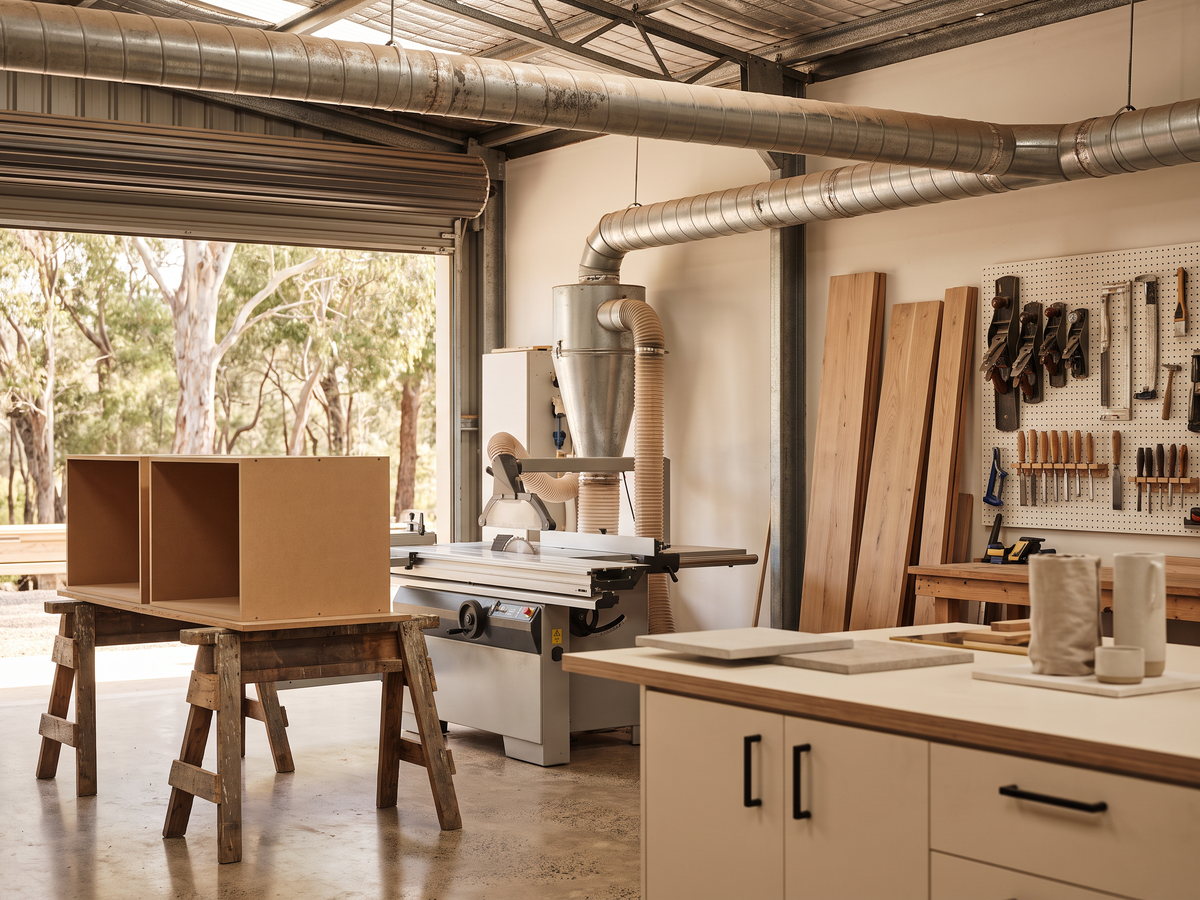
Custom joinery needs machinery because repeatable accuracy is a safety and quality control issue. Panel saws, CNC equipment, edgebanders, drills, clamps, benches and dust extraction are capital and maintenance costs. They also change the result: a precise, labelled cabinet delivered in sequence is not the same as a pile of cut board made up on site.
Silica compliance belongs in the same honest conversation. The prohibition on engineered stone commenced in the national framework from 1 July 2024, with the NSW regulatory context set out by SafeWork NSW. Where benchtops are part of a job, specify the material and fabricator rather than leaving a vague “stone allowance”.
Why a cheap hourly rate is usually a risk transfer
A low rate is not automatically bad. A sole trader with a simple, local task and low overhead may price differently from a workshop delivering a full kitchen. The problem is when the low rate is attached to an undefined scope. The missing cost does not vanish; it moves to the client as a variation, delay, weak warranty response, cash request or unfinished detail.
| Low-quote signal | Why it matters | Ask for |
|---|---|---|
| No licence details | You cannot verify the contractor | Licensee name, licence number and category |
| “Materials extra” without allowance | Total cost is unknowable | Named materials and GST basis |
| “Soft-close included” without brand | Hardware can be substituted | Brand, model and quantity |
| Cash-only or no written scope | There is little evidence of agreement | Written contract and variations process |
| Large upfront request | Cashflow risk may sit with the client | Lawful payment schedule and milestones |
| No allowance for installation | The job may stop at delivery | Installation, access and protection inclusions |
For a more complete buyer checklist, use these questions to ask a custom joiner. The aim is not to interrogate a good trade; it is to make the job comparable before the deposit.
What this means when you compare two quotes
Put both quotes on one worksheet. First normalise GST. Then list every cabinet run, board, door finish, hardware line, benchtop interface, delivery item and exclusion. If one price allows for laminate and another specifies two-pack, they are not competing for the same product. If one includes removal and protection and another does not, the price gap is not pure profit.
Use our cabinetry cost per linear metre guide to understand the finish unit, then compare the whole room. For the broader renovation picture, see custom kitchen costs in NSW. A workshop should welcome this level of comparison. It makes arguments about a bare hourly rate much less important.
A practical way to buy by scope, not by anxiety
Start with a single measured brief. It does not need to be an architectural specification, but it must identify the wall, the overall dimensions, the rooms, the intended finish, doors, drawers, internal storage, benchtop or appliance interfaces, removal work and the desired installation window. Send that same brief to each contractor. Asking three people to interpret a photo and then comparing the totals will only produce three different jobs.
At quote stage, have a short clarification meeting. Ask the maker to point to the costly decisions. Is it the number of drawer boxes, the painted finish, a curved end, a false panel needed for services, the site access, or a benchtop interface? A good answer is specific. “It is custom” is not enough.
Then look at the payment schedule alongside the price. A joinery project necessarily commits materials before installation, but the schedule should connect payments to documented progress and the contract. Do not confuse a low deposit with low project risk, and do not confuse a fast verbal promise with capacity. The written scope, current licence, named materials and a realistic programme are stronger signals.
One more point about installation: workshop hours can be efficient because machines, benches and dust control are in one place. Site hours are often slower because access, protection, existing walls, other trades and clean-up intervene. A quote that uses a higher workshop component is not automatically padded. It may be choosing the safer way to make a precise product before the small, carefully controlled site installation.
If an allowance has not been finalised, write down the trigger for final price. For example, a benchtop can be subject to final template; an appliance panel can be subject to the model being supplied; and a wall can be subject to final measure after demolition. Those are normal uncertainties. The problem is not an allowance. The problem is an allowance with no description, no GST basis and no process for approval.
Finally, compare who owns the coordination. A cabinetmaker can supply and install cabinetry, but the job may still need plumbing, electrical, stone fabrication, flooring or painting. A low joinery rate can be perfectly legitimate if another contractor is coordinating those trades. Record that division of responsibility before accepting the quote. It prevents a client waiting for a service opening that neither contractor believes they own.
Use a variation form for changes after approval. It should describe the changed item, price effect, programme effect and acceptance. That short record protects both parties and stops an apparently small decision becoming an argument at installation.
The best comparison leaves both parties clear about the same finished result, who supplies each interface and how changes are approved. That is better value than an hourly figure that cannot be audited after work starts.
Rates across NSW
No verified Newcastle-specific cabinetmaker charge-out figure is available in the research for this guide, so I will not invent one. Published Sydney data is a comparator, not a Newcastle price list. Local cost-to-serve varies with travel, parking, strata bookings, access, project density and whether the job can be made and installed in one efficient run.
| NSW region | Cost-to-serve driver |
|---|---|
| Newcastle | Measure-to-workshop logistics and detached-house access |
| Lake Macquarie | Travel around the lake and varied housing stock |
| Central Coast | Coastal travel and holiday-home access windows |
| Maitland | New-estate coordination and second-fix timing |
| Hunter Valley | Longer delivery runs and rural access |
| Sydney CBD | Loading docks, lift bookings and restricted hours |
| Inner Sydney | Parking, strata and tight delivery paths |
| Wollongong | Inter-regional travel and coastal conditions |
SteepWood is Pavit Cabinetry Pty Ltd trading as SteepWood, NSW Carpentry Contractor Licence 489553C (verify a contractor licence through Service NSW), ABN 52 697 313 269, and NSW requires a licence for residential building work above $5,000 including GST. You can read about our workshop and credentials, and our service information for Newcastle and Sydney describes the areas we serve.
FAQ
What does a cabinetmaker earn per hour in NSW?
Published Joinery and Building Trades Award base rates are about $25.74 to $27.97 per hour for the classifications cited here. That is an employee wage floor, not what a workshop invoices a client. Individual pay can differ by classification, experience, allowances and employment terms.
Why is the charge-out rate four times the wage?
A charge-out rate funds more than the maker's wage. It has to recover employment on-costs, non-billable time, workshop rent, machinery, insurance, consumables, administration, warranty responsibility and a viable business margin. Assess the written inclusions and project scope, rather than deciding from a wage-to-rate ratio alone.
Is $80 an hour a fair joinery rate?
It can be fair for a defined task, but an hourly number alone is not enough to judge a joinery quote. Ask whether it includes GST, travel, materials, workshop time, supervision, installation and rectification. Compare the total written scope and the responsibility for the finished job.
Do joiners charge for the measure and quote?
Some joiners include an initial measure and quote, while detailed design, drawings or repeated revisions may be charged or credited under their terms. Ask before booking what the appointment produces, what is included and when a preliminary allowance becomes a fixed scope. Put the answer in writing.
What insurance should a joiner hold?
Ask a contractor for evidence of the insurances relevant to the job, including public liability and workers compensation where applicable. For residential work, also check the licence, contract and HBCF position where the statutory threshold is met. The appropriate cover depends on the project and contractor.
What happens if I hire an unlicensed cabinetmaker?
For residential building work above the NSW threshold, hiring an unlicensed operator can remove important protections and create a compliance problem. Verify the contractor through the NSW licence check, confirm the contract and ask about HBCF where the work reaches its threshold. Do this before any deposit is paid.
STEEPWOOD CUSTOM JOINERY — We price a defined scope from our Newcastle workshop, with the material and installation assumptions stated clearly. Get a free measure and quote.