Custom laundry joinery in New South Wales is usually an indicative 2026 range of $3,000 to $25,000 plus including GST, from a compact cabinet refresh to a walk-through room with tall storage and a drying cupboard. That is a wide band because a laundry is not just cupboards: water, drainage, power, damp clothing and awkward appliance clearances all land in the same small room. Australia is also the world’s highest-intensity laundry-renovation search market, at 6.13 searches per 100,000 people each month, so it is remarkable how few guides explain what the joinery itself costs (Compare the Market).
I price a laundry by the run of cabinetry, the finish, the hardware and the services that sit behind it. Start there, rather than with a glossy photo. A door-heavy room can cost more than a longer open-shelf run; moving a tub can cost more than choosing a better handle.
The short answer
A modest laundry renovation is commonly quoted from roughly $3,000, while a comprehensive room can pass $25,000, depending on scope (Reno Page). As a working allowance, cabinetry commonly represents 35–45% of a fitted-room renovation budget (LeadKit). The balance is the part people forget to carry: trades, surfaces, demolition and making good.
| Laundry brief | Joinery scope | Indicative 2026 total, including GST | The cost trigger |
|---|---|---|---|
| Compact refresh | 1.8 m base and overhead run, laminate doors, open shelf | $3,000–$7,000 | Existing services remain usable |
| Standard family room | 3 m L-shape, tall broom unit, drawers, laminate top | $9,000–$16,000 | More corners, storage and hardware |
| Walk-through utility room | Two runs, drying cupboard, tall storage, premium top | $18,000–$25,000+ | Services, tall units and a larger fitout |
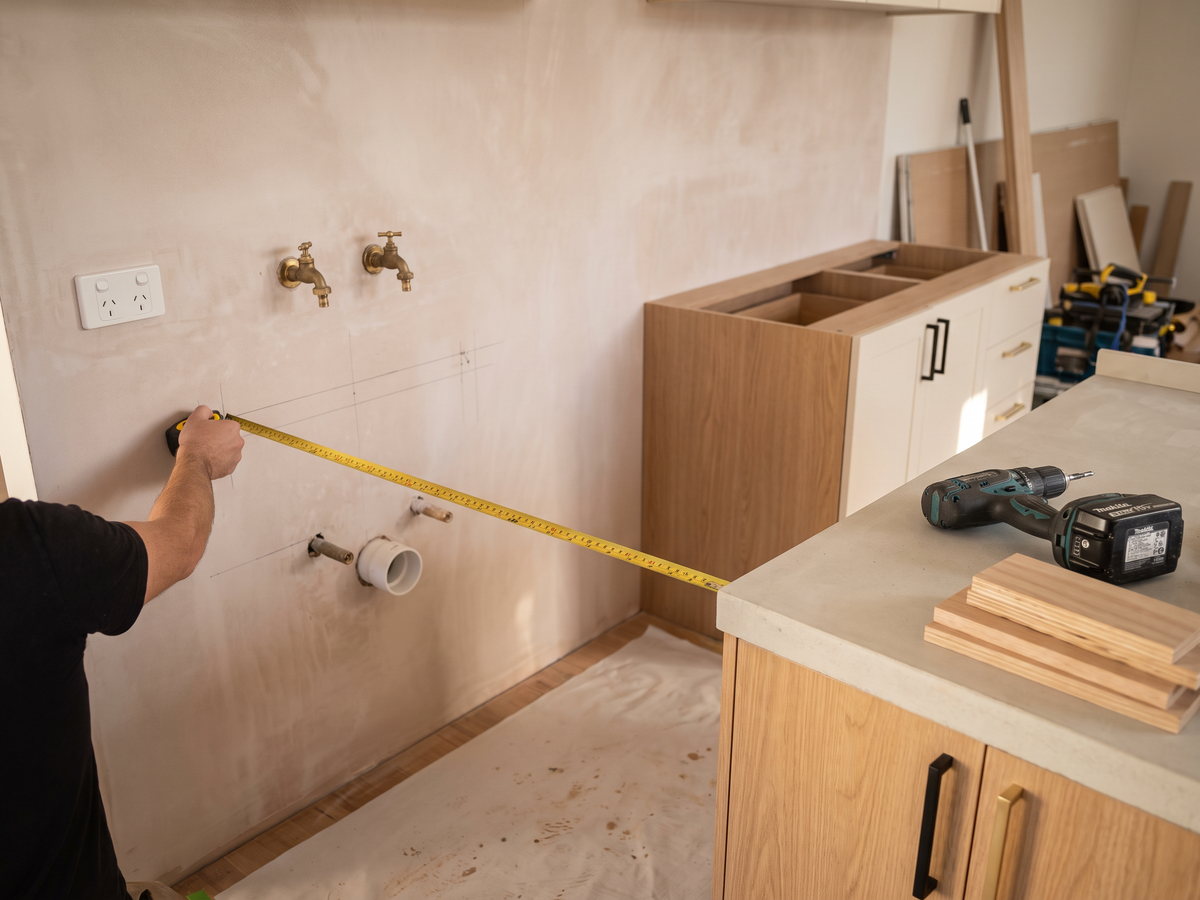
Those are planning ranges, not a SteepWood quote. A proper measure decides whether the wall is straight, where the traps and valves sit, and whether a full-height cabinet can actually be installed without blocking a meter box or a window.
What actually drives a laundry price
The first driver is layout. A straight 1.8 metre run is efficient to manufacture and install. An L-shape adds a corner, end panels and more templating. A walk-through laundry usually needs tall storage on at least one wall, and tall storage is not simply more of the same cabinet: it needs a different internal specification, more material and a clear plan for access.
The second driver is the substrate and door finish. Laminated board is practical in a laundry when the edges are protected and water is not allowed to sit against them. Polytec and Laminex both make durable cabinet finishes that make sense here. A two-pack polyurethane door is smoother and more repairable as a painted finish, but spraying adds cost. Timber veneer can look excellent in a connected kitchen-laundry scheme, but the room must still be treated as a wet-service environment, not a living room.
Third is the drawer count. A cupboard with shelves is cheaper than a bank of deep drawers because drawers carry runners, fronts, assembly time and adjustment. Retail pricing illustrates the difference: a Blum LEGRABOX drawer system starts from $233 including GST, while a soft-close hinge starts around $14 (eKitchens hardware guide). The price is not just the metal. It is the cabinet construction required to let the hardware work properly.
Finally, do not confuse the cabinet number with the renovation number. In an existing laundry, a moved washing-machine point, a new floor waste, a tiled splashback or a new electrical circuit can quickly become the dominant cost. This is where people waste money: they approve cabinetry before asking where every hose, waste pipe and power point will go.
Three costed laundry builds
The line items below are deliberately separated. They show the decision points rather than pretending every laundry can be reduced to one rate.
| Line item | Compact 1.8 m single run | Standard 3 m L-shape | Walk-through with drying cupboard |
|---|---|---|---|
| Design, measure and shop drawings | $450–$800 | $750–$1,200 | $1,100–$1,800 |
| Cabinet carcasses, doors and panels | $1,900–$3,400 | $5,100–$8,400 | $10,000–$15,000 |
| Drawers, hinges and internal fittings | $300–$900 | $900–$1,800 | $1,900–$3,400 |
| Benchtop and sink cut-out allowance | $350–$850 | $750–$1,800 | $1,500–$3,200 |
| Delivery and installation allowance | $450–$1,050 | $900–$1,800 | $1,800–$3,500 |
| Joinery total including GST | $3,450–$7,000 | $8,400–$15,000 | $16,300–$26,900 |
| Trades and finishes, if required | $0–$4,000 | $2,000–$8,000 | $5,000–$15,000+ |
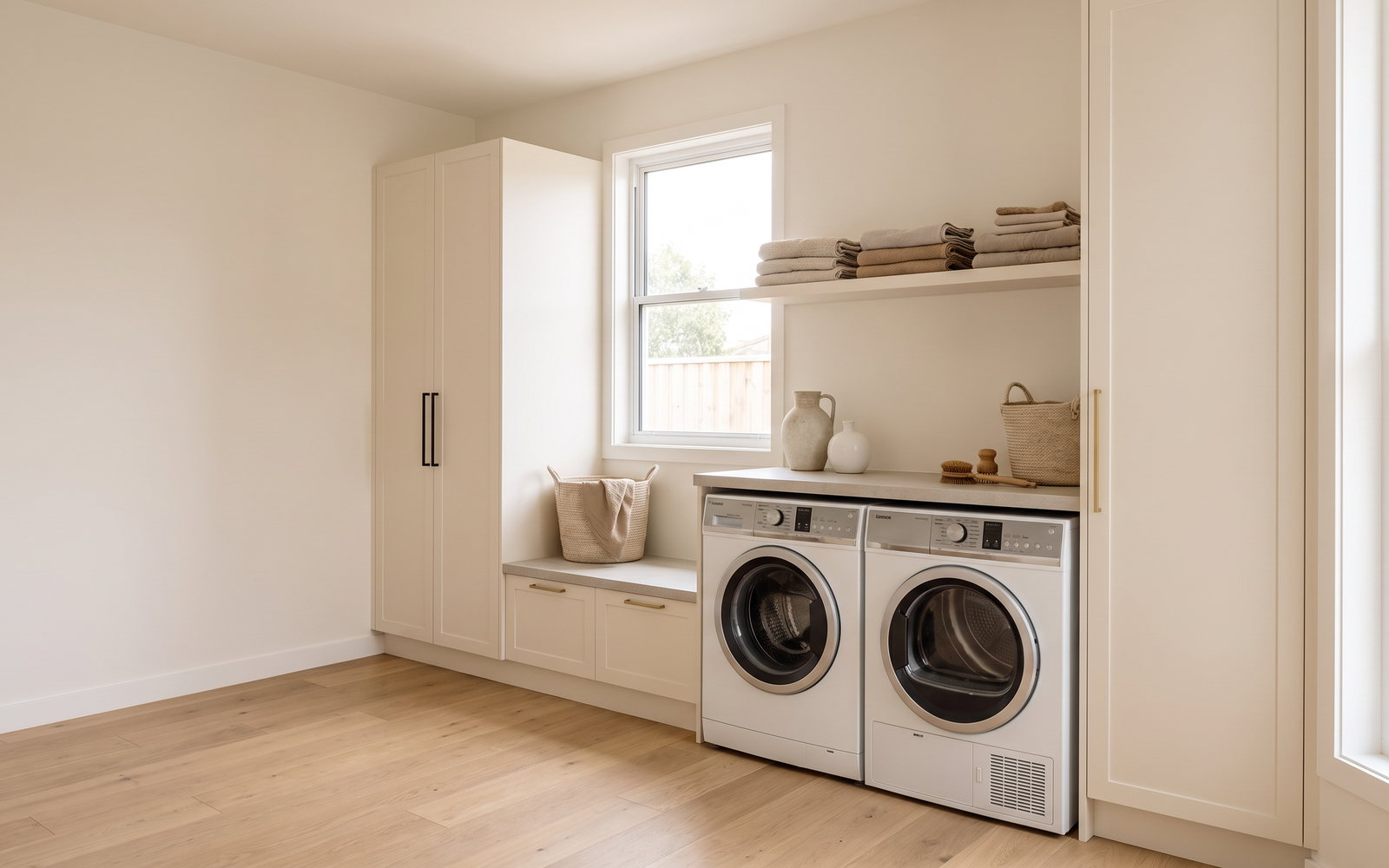
The compact build suits a laundry tucked against one wall in a Newcastle cottage, an apartment utility nook or a secondary laundry in a larger home. It should have at least one proper folding surface, a logical landing place for a basket and service access that does not require dismantling cabinetry. If the machines sit under the bench, use removable or adjustable panels where the valves and traps need future access.
The standard L-shape is where families start to ask for a tall broom cupboard, pull-out hampers and a place to store cleaning chemicals above child reach. It is also where a cheap quote becomes hard to compare. One contractor may include every end panel and the appliance fillers; another may carry them as variations. Ask for a cabinet-by-cabinet schedule.
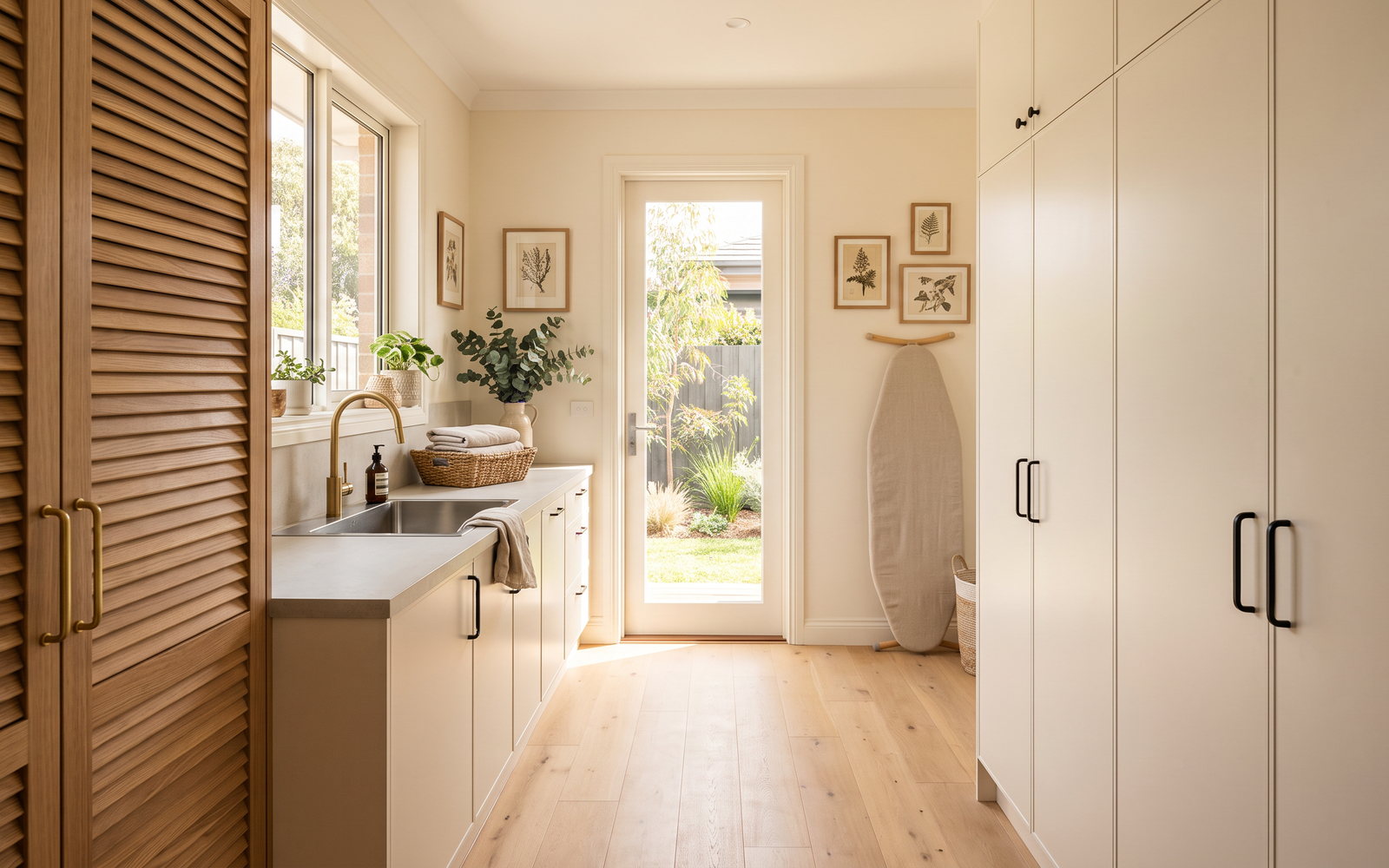
The walk-through version is a utility room, not merely a laundry. It earns its spend when it removes daily clutter from the kitchen: a drying cupboard, linen storage, a second prep surface, pet supplies or a concealed charging shelf. It is not good value simply because the house plan has a spare narrow passage. If there is no adequate aisle once doors and baskets are in use, the premium room will feel like a corridor with expensive cupboards.
STEEPWOOD LAUNDRY CABINETS — A laundry works when the appliance, tub and storage sequence is measured before the cabinets are made. Get a free measure and quote for a clear joinery scope across NSW.
Cabinetry cost per linear metre by finish
Per-linear-metre pricing is a comparison tool, not a quote. It is useful only when you know whether the figure refers to base units, overheads, tall cabinets, installation, drawers and end panels. Current Sydney market ranges put laminate cabinetry around $800–$1,400 per linear metre, polyurethane at $1,400–$2,200, two-pack at $1,800–$3,000 and timber at $2,200–$4,000 plus (LeadKit’s 2026 market guide). Use the figures as a finish comparison, then measure the actual composition of your room.
| Finish | Indicative cabinetry range per linear metre | Best use in a laundry | Watch for |
|---|---|---|---|
| Laminate | $800–$1,400 | Durable family rooms and rental refreshes | Damaged exposed edges near water |
| Polyurethane | $1,400–$2,200 | Smooth contemporary doors and colour matching | Higher finishing and repair cost |
| Two-pack | $1,800–$3,000 | Profiled doors and premium painted schemes | Door count matters more than run length |
| Timber or timber feature | $2,200–$4,000+ | Feature shelf, bench return or connected interior | Moisture movement and sealing discipline |
A laundry with mostly overhead cupboards should not be compared directly with a kitchen-style lower run full of drawers. The former can have a lower rate because it uses fewer runners and less load-bearing cabinet structure. A tall drying cupboard can have a higher apparent rate because it includes full-height doors, internal shelves, ventilation clearances and often lighting or electrical coordination.
For finish detail that applies across the house, see our cabinet finish comparison. If the laundry shares sightlines with the kitchen, take the kitchen door sample into the laundry and view both in the actual light before locking in a colour.
Benchtops that survive a laundry
Laminate is the straightforward choice for most laundry benches. It is cost-effective, easy to wipe down and available in practical neutral colours. It is not immune to water damage at cut-outs, joins or a damaged edge, so a good installation matters more than a product brochure.
Porcelain and sintered stone make sense when the laundry is part of an open utility or mudroom scheme and the top will be used heavily for folding, soaking or cleaning. Indicative installed ranges for porcelain and sintered products sit around $900–$1,400 per linear metre, compared with $450–$1,200 for the engineered-stone category cited in historical market guidance (Konnect Kitchens). Engineered stone containing at least 1% crystalline silica is prohibited in NSW, while porcelain without resin and sintered stone without resin are outside that definition (SafeWork NSW).
The better question is not “what top is strongest?” It is “where will water sit and how will the edge be protected?” Put the tub and tap placement on the joinery drawing. Confirm who is making the cut-out and who is responsible for sealing it. This is a small detail that prevents a swollen panel years later.
Hardware, and why the drawer box is the price
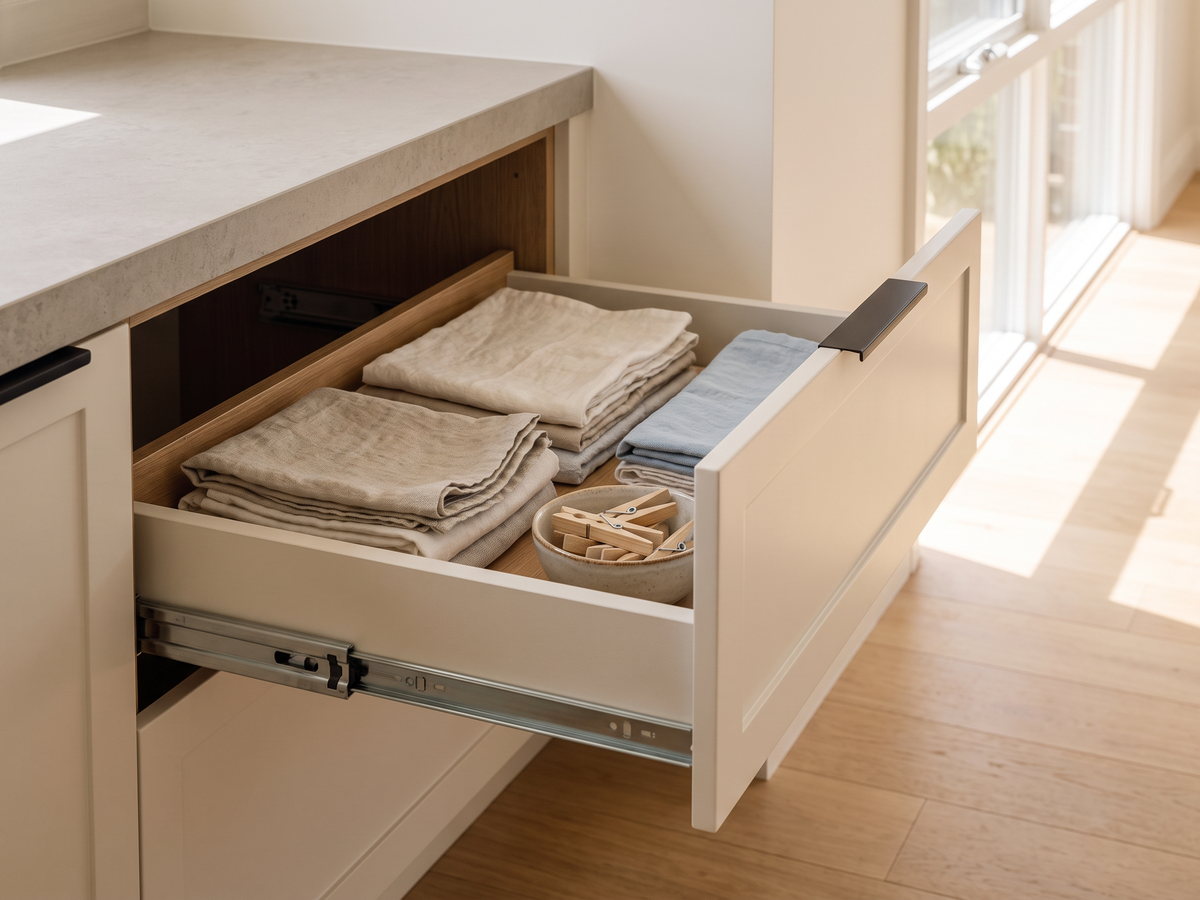
There is no virtue in putting premium drawer systems everywhere. A tall broom cupboard needs sturdy adjustable shelves before it needs an expensive pull-out. A deep basket drawer below the bench, however, gets used constantly and is a good place to specify full extension and soft close.
Specify function first:
- deep drawers for detergent bottles and folded linen;
- a shallow top drawer for pegs, stain products and scissors;
- adjustable shelves for a changing mix of cleaning supplies;
- a pull-out hamper only if there is room to remove and clean it; and
- soft-close hinges on full-height doors where a slammed door can shake the whole cabinet.
Retail hardware pricing moves, but it makes the cost mechanism visible. LEGRABOX starts at $233 including GST and soft-close hinges at about $14 (eKitchens). Multiply that by several drawers, add the door or drawer front and allow the labour to assemble, install and adjust it. The “hardware upgrade” is a real build component, not a line added because the word premium sells.
What sits outside the joinery quote
A good joinery quote should tell you exactly what it does not cover. That is not a disclaimer; it is the information required to budget a room properly.
| Usually in a joinery scope | Usually separate unless expressly included |
|---|---|
| Cabinetry, doors, panels and fillers | Demolition and rubbish removal |
| Specified hinges, runners and handles | Plumbing rough-in and fit-off |
| Shop drawings and cabinet manufacture | Electrical circuits, outlets and lighting |
| Delivery and cabinet installation | Tiling, plastering, painting and flooring |
| Benchtop only if itemised | Waterproofing, floor waste and certification |
| Appliance housing and fillers | Washing machine, dryer, tub, tapware and ventilation |
For a laundry, waterproofing is a trade decision, not a cabinetmaker’s shortcut. The National Construction Code includes specific wet-area provisions, including water-resistant requirements around washing-machine taps and for laundry floors and junctions (NCC wet-area provisions). Have the builder or relevant trade confirm the applicable NSW compliance pathway for your property before cabinetry is installed.
Laundry joinery across NSW
Housing stock changes the brief. A compact strata laundry in the City of Sydney has different constraints from a freestanding Central Coast house, even when the cabinet finish is identical. The table does not pretend to prescribe price by postcode. It identifies the practical variable to raise at the first measure, based on local housing and renovation conditions.
| NSW region | Typical laundry footprint and dominant housing variable | What to resolve first |
|---|---|---|
| Newcastle | Separate houses are 69.0% of stock; renovations totalled $115.526 million in 2025–26 (ABS data via location strategy) | Side-room access, older services and coastal moisture |
| Central Coast | Largest dwelling stock outside Sydney, with 152,706 dwellings (ABS data via location strategy) | Family storage and salt-air material discipline |
| Lake Macquarie | $92.577 million of approved alterations in 2025–26 (ABS data via location strategy) | Existing-room irregularities and utility storage |
| Northern Beaches | $414.629 million of alterations in 2025–26 (ABS data via location strategy) | Access, parking and a premium connected fitout |
| Inner West | $300.441 million of alterations in 2025–26 (ABS data via location strategy) | Terrace widths, walls and shared boundaries |
| City of Sydney | Separate houses account for 2.1% of housing stock (ABS Census) | Strata approval, lifts and compact appliance layouts |
| Blue Mountains | Separate houses account for 92.1% of housing stock (ABS Census) | Older-room levels, cold-weather drying and storage |
| Wollongong | $117.062 million of approved alterations in 2025–26 (ABS data via location strategy) | Coastal exposure and live-in renovation staging |
For Newcastle work, our Newcastle laundry cabinetry page is the relevant service starting point. For broader project planning, read the NSW custom kitchen cost guide, because the same questions about a fixed footprint, trades and inclusions apply to a utility room.
Apartment work needs extra time before a cabinet order. NSW says a kitchen or bathroom renovation and changes requiring waterproofing need strata permission; owners should check the scheme’s by-laws and approval process before committing to work (NSW strata renovation rules). A laundry may be smaller, but it can still involve waterproofing, plumbing and common-property questions.
Where people waste money
The first waste is a decorative drying cupboard with no real drying strategy. If it will hold wet clothes, establish ventilation, clearances, power requirements and condensation management before making a tall cabinet. A cabinet cannot make damp air disappear.
The second is buying appliances after cabinetry is approved. Appliance widths are not a complete specification. You need the manufacturer’s service clearances, hose route, plug location, door opening and access for replacement. I would rather have a plain removable panel in the right place than a perfect-looking installation that needs its benchtop removed to change a hose.
The third is an oversized tub that destroys usable bench space. A laundry tub is useful, but it should fit the actual jobs you do. If a generous tub leaves no landing surface and forces every folded item onto the machine lid, the room is not working.
The fourth is treating a laundry as a miniature kitchen. Use drawers where drawers help. Use doors and adjustable shelves where they do the job more economically. Put money into moisture protection, service access and a sensible sequence before adding organisers that make the quote look impressive.
For a complete room brief, start with custom laundry cabinets, then compare the room against custom kitchen joinery. We also service the Newcastle area and the Central Coast, where access and coastal conditions belong in the first measure.
How SteepWood quotes a laundry
We start with the room, the appliance specifications and the actual work you do there. The first conversation should cover whether the laundry is separate, part of a mudroom, behind doors in a hall or attached to the kitchen. We then measure services, walls, openings and access before settling the cabinet configuration.
The proposal should separate joinery from separate trades, identify the door finish and hardware, and state whether the benchtop, tub, tapware and appliances are included. If a change in scope affects plumbing, waterproofing or electrical work, it should be priced before manufacture rather than discovered when the installer arrives.
SteepWood is Pavit Cabinetry Pty Ltd trading as SteepWood, NSW Carpentry Contractor Licence 489553C, ABN 52 697 313 269. NSW requires a licence for residential building work above $5,000 including GST (NSW Government contract guidance). Work above $20,000 requires the larger contract pathway and Home Building Compensation cover before a deposit is taken where the scheme applies (NSW Government contract guidance).
FAQ
How much does a custom laundry cost in NSW?
A custom laundry in NSW is commonly about $3,000 to $25,000 plus, depending on the room, finishes, benchtop and whether plumbing moves. A compact cabinet run can be sensible at the lower end; a walk-through laundry with tall storage, a drying cupboard and services belongs at the upper end. Compare every quote on inclusions, not its headline total.
Is custom laundry joinery worth it over flat-pack?
Custom laundry joinery is worth it where the room is narrow, has awkward services, needs tall storage or must cope with daily family use. Flat-pack can be enough for a square, low-use room when the standard modules fit cleanly. The expensive mistake is buying flat-pack first, then paying to adapt plumbing, fillers and panels around it.
How long does a laundry fitout take?
The on-site cabinet installation for a prepared laundry is usually short, but the overall programme depends on design approval, fabrication, benchtop timing and any plumbing, electrical, tiling or waterproofing work. Treat a full renovation as a coordinated trade sequence rather than a cabinet delivery date. Confirm the workshop lead time and each trade booking before demolition.
Do I need a licensed builder for a laundry renovation?
In NSW, residential building work above $5,000 including GST requires an appropriately licensed contractor and a written contract. Work over $20,000 has additional contract and Home Building Compensation cover requirements. Plumbing, electrical and waterproofing also need the right qualified trade, so a joinery quote should state plainly which work it excludes.
What benchtop is best for a laundry?
Laminate is the sensible value choice for most laundries because it is easy to clean and gives a broad colour range. Porcelain or sintered stone is appropriate where a hard-wearing folding surface, heat resistance or a continuous premium finish matters. The important detail is a properly supported top, sealed sink cut-out and a layout that keeps standing water away from board edges.
Can you fit a laundry into a cupboard?
Yes, a laundry can fit into a cupboard if appliance ventilation, door swing, power, water, drainage and service access are resolved before cabinetry is made. A cupboard laundry works best when the machines, tub and shelves have a deliberate sequence. It is not simply two doors placed in front of a washing machine.
STEEPWOOD LAUNDRY CABINETS — A measured laundry plan is cheaper than changing services after the cabinets arrive. Get a free measure and quote and we will define the joinery scope before you commit.