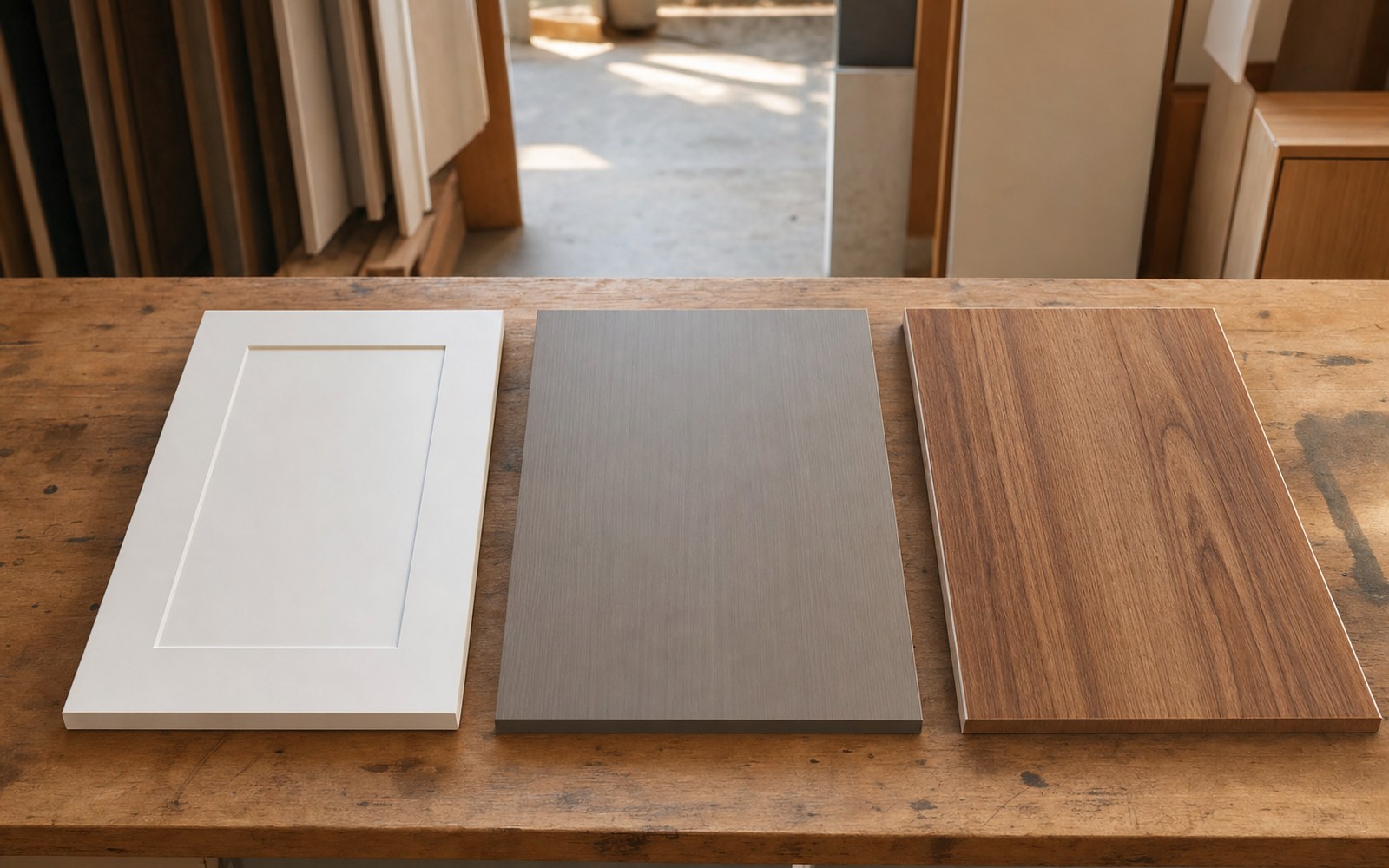
Three clients in the past month have walked into the Newcastle workshop with the same question. They have been online for weeks, they have visited a couple of showrooms, they have a rough idea of what they want their kitchen to look like — and they cannot work out what the salesperson actually means when they say "2-pac finish" versus "Polytec laminate" versus "veneer wrapped doors". The trade language has leaked into consumer conversations without the explanations attached. This guide unpacks each finish honestly, names the specific Australian products you will encounter, compares real installed costs, and explains — with the directness that comes from building kitchens on the NSW coast for over a decade — which finish suits which home and which environment.
For a broader materials overview covering substrates, hardware, and construction methods, see our joinery materials guide covering 2-pac and timber. This post goes deeper on finishes specifically: what they are, how they perform in coastal NSW conditions, and what they actually cost per door.
What these finishes actually are
The confusion starts with terminology. A door finish is the outermost layer — what you see, touch, and clean. It sits on top of a substrate (usually MDF, MR board, or plywood) and is what determines the colour, texture, durability, and maintenance requirements of your cabinetry.
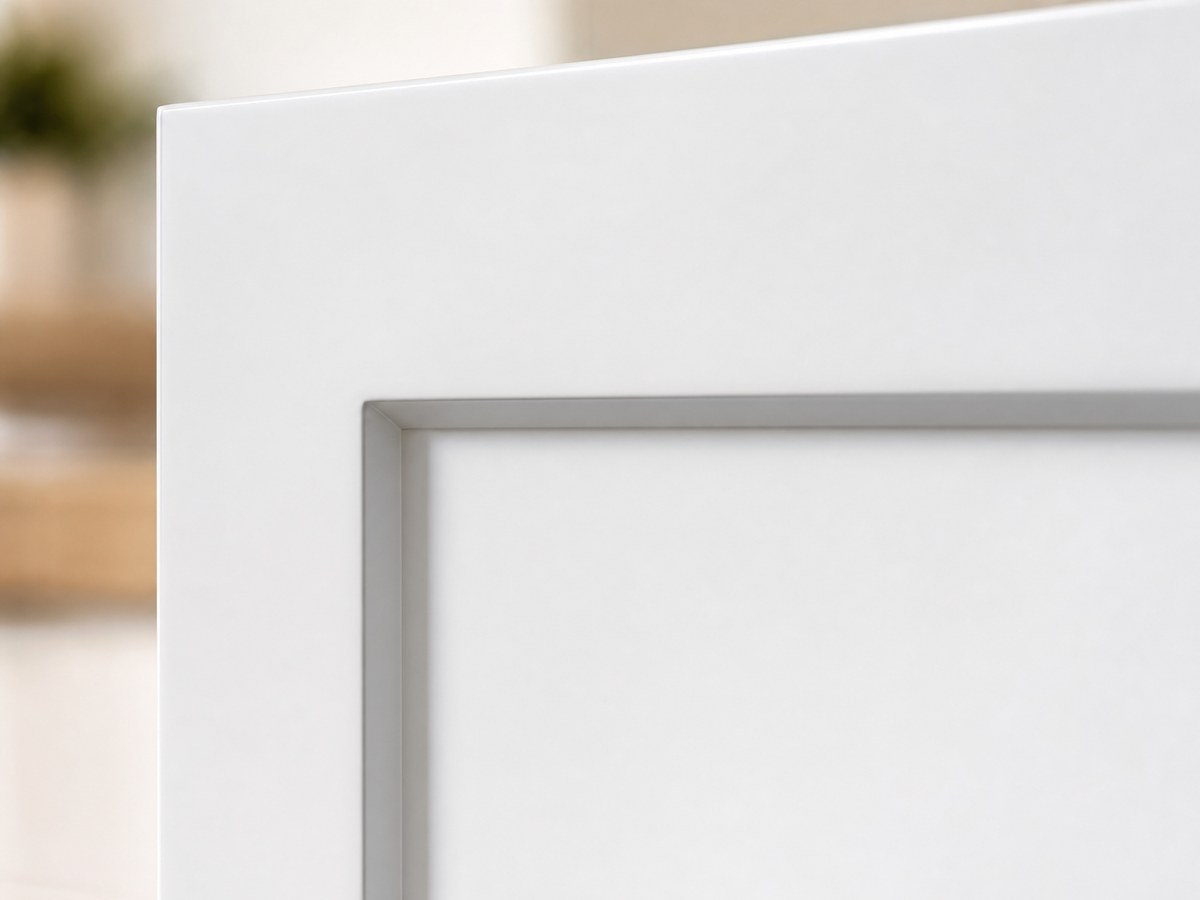
2-pac is short for two-pack polyurethane. A spray-applied finish, it is mixed from two components — a resin and a hardener — that chemically bond as they cure. The result is a hard, non-porous film applied directly over a prepared substrate, most commonly MDF or MR (moisture-resistant) board. It is not a sheet product; it is painted on in the workshop. This is why 2-pac gives a seamless result: there are no joins, no visible substrate edges under the film, and the finish wraps the entire door surface.
Laminate is a pre-finished decorative sheet — a paper or resin layer with colour or texture already set into it — bonded to a substrate panel using heat and pressure. In Australian kitchens, the dominant suppliers are Polytec and Laminex. The substrate is usually MDF, MR board, or particleboard. The laminate is applied to the front face and edges of the door panel, and the quality of the edge-banding is a significant indicator of overall workmanship.
Timber veneer is a thin slice of real timber — typically 0.5 mm to 0.9 mm — bonded to a substrate panel. It looks and feels like solid timber because the grain and figuring you see are genuine. The veneer is then sealed, lacquered, oiled, or 2-pac'd over the top to protect it. The substrate is almost always MR board or structural ply. Veneer is not the same as a timber-look laminate: the grain is real, the variation is real, and the ageing is real.
2-Pac (polyurethane) — what it is, who specifies it, the AU brands
2-pac polyurethane has been the benchmark painted kitchen finish in Australia for roughly 25 years. Its reputation is earned: done correctly, on the right substrate, it is hard-wearing, moisture-resistant, and produces the cleanest, most consistent painted surface available for joinery.
Who specifies it
In NSW, 2-pac is most commonly specified on custom kitchen joinery in the mid-to-premium price bracket: any project where the client wants a smooth painted result and is prepared to invest in longevity. It is also the standard finish for custom bathroom vanities — see our custom bathroom vanity service — where moisture resistance and cleanability matter most. Architects and interior designers working on higher-end NSW residential projects almost universally specify 2-pac for painted cabinetry.
The AU brands
The two dominant 2-pac paint systems used by Australian cabinet painters are Dulux and Wattyl. Both supply professional two-pack polyurethane systems in a full colour range — any colour on the Dulux or Wattyl chip deck can be matched, which means you are not limited to a manufacturer's catalogue. This is one of 2-pac's clearest advantages over laminate: you can match your joinery precisely to a wall colour, a fabric, or a custom Pantone reference.
The finish is spray-applied in a controlled workshop environment. Quality is entirely dependent on surface preparation, substrate quality, and the skill of the sprayer. A correctly sprayed Dulux 2-pac finish on MR board, with proper sealing coats and sanding between coats, will be almost impossible to distinguish from a high-end European lacquered finish at normal viewing distance.
Finish options
2-pac is available in matt (10–15% sheen), satin (25–40% sheen), and gloss (60–80%+ sheen). In 2026, the industry has moved decisively toward matt and satin. High-gloss 2-pac looks exceptional in professional photography and in well-lit showrooms; it shows every fingerprint and minor scratch in a real kitchen. Matt 2-pac conceals daily wear, photographs beautifully in natural NSW light, and fits the warm minimalism trend that is currently the dominant brief across Newcastle, the Central Coast, and the Hunter Valley.
Cost per door
- 2-pac matt or satin: $180–$350 per door installed
- 2-pac gloss: $250–$450 per door installed
The variation within those ranges reflects substrate choice (MDF vs MR board), door profile complexity (flat slab vs routed profile vs shaker), and the number of coats specified.
Laminate — the AU brand landscape
Laminate is not a second-rate finish. For budget-conscious projects, for rental properties, and for clients who want the reliability of a tested colour range, high-quality laminate on a correct substrate performs well for 10–15 years with minimal maintenance. The problem is not laminate as a category — it is low-quality laminate on cheap particleboard substrate with poor edge-banding, which is what you get from flat-pack cabinet systems.
In the custom joinery context, laminate means Polytec or Laminex sheet products applied to a properly constructed door, edge-banded correctly, with a quality substrate. This is a different product class from a flat-pack laminate door, and it is worth understanding that distinction before dismissing laminate entirely.
Polytec
Polytec is the market leader for decorative surfaces in Australian joinery. Their door and panel range covers solid colours, woodgrains, textured surfaces, and high-gloss options, and is updated with new launches each year.
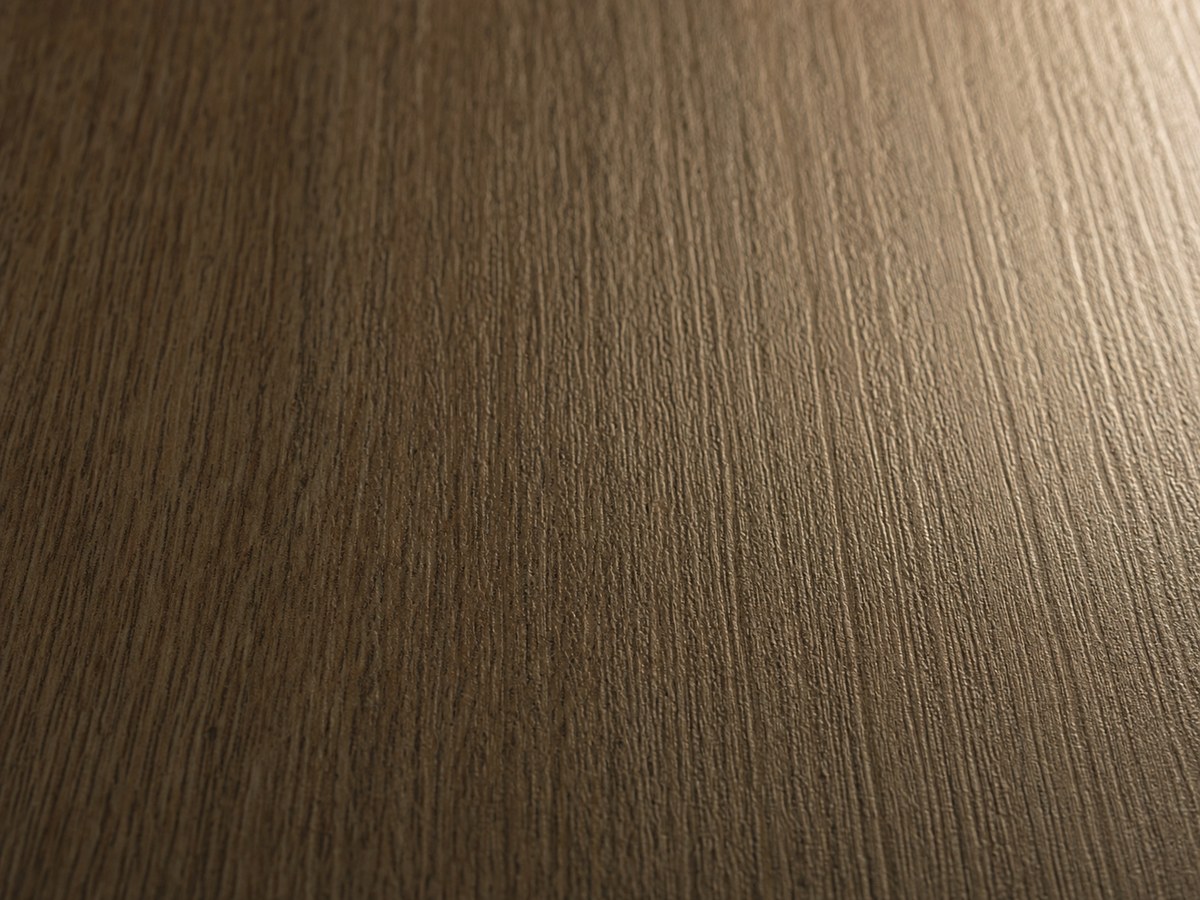
The standout product for 2026 is Polytec SYNC. This is a textured woodgrain surface where the visual print and the physical texture are synchronised — the raised grain texture you feel under your hand corresponds exactly to the grain pattern you see. The result is a surface that reads convincingly as timber at close range. Current popular specifications from the SYNC range include Classic Oak, Natural Walnut, and Driftwood in a range of tonal variations. SYNC doors on MR board substrate, correctly edge-banded, are what we most commonly specify at SteepWood when a client wants the warmth of timber at a laminate price point.
The Polytec Createc range covers solid colours in a matte and satin finish — a mid-tier 2-pac alternative for clients who want a clean painted look without the spray-paint premium. The Polytec Ravine range adds a deep V-groove linear texture, suited to coastal and Hamptons-influenced kitchens.
As part of their 2026 colour refresh, Polytec has expanded the warm earthy tones in both the SYNC and Createc ranges — reflecting the broader industry shift away from stark white and cool grey toward natural greens, warm taupes, and mid-browns.
Laminex
Laminex is the other dominant supplier and the one most Australian homeowners have already encountered, usually without realising it. Their products appear in Bunnings and across the trade supply network.
The Laminex Woodmatt range has been a workhorse of Australian kitchen laminate for over a decade. Woodmatt finishes have a low-sheen, slightly textured surface that conceals wear reasonably well and photographs well in residential settings. Classic Oak and Tasmanian Oak Woodmatt are still among the most commonly specified laminate finishes in NSW kitchens in 2025–26, according to Intero.com.au's popular Laminex colours survey.
The Laminex Diamond Gloss range sits at the other end — very high-gloss surfaces for contemporary kitchens. The same observations about gloss maintenance apply here as to 2-pac gloss: beautiful in photographs, demanding in day-to-day use.
The Laminex Colour Collection 2026 refresh has brought a number of new warm tones into the range — soft clay, warm sage, and a series of deep neutrals that are directionally aligned with what Polytec is doing. The competition between the two brands on colour and texture has been good for consumers: both ranges are more sophisticated than they were five years ago.
Comparing Polytec and Laminex
For a detailed Polytec vs Laminex comparison, Cutbybees provides a useful overview of the brand differences from a trade perspective. In practice, the choice between them often comes down to the specific colour or texture you want: if the Polytec SYNC Classic Oak is the visual you are after, you specify Polytec. If the Laminex Woodmatt Tasmanian Oak matches your floor better, you specify Laminex. Both are quality products when correctly applied.
Cost per door
- Laminate (Polytec or Laminex, on MR board): $80–$180 per door installed
Timber veneer
Timber veneer occupies a different category from 2-pac and laminate: it is the only kitchen finish that genuinely ages, that develops character with use, and that connects the finished kitchen directly to Australian material heritage. It is also the most demanding to specify, the most variable in result, and the most expensive of the three.
Species available in NSW
The most commonly specified timber veneer species for NSW kitchen joinery are:
Spotted Gum (Corymbia maculata) — a NSW-native hardwood with interlocking grain that creates a fiddleback figure in some cuts. Mid-brown to warm chocolate tones. Highly durable and one of SteepWood's preferred species for feature island panels and kitchen joinery in heritage properties in the Newcastle and Hunter Valley region.
Tasmanian Oak — the commercial standard for Australian joinery veneer. Pale pink to cream in colour, consistent grain, widely available, and well suited to kitchens where you want a lighter, Scandinavian-influenced feel. It takes stain well, so it can be shifted toward walnut-adjacent tones if required.
Blackbutt (Eucalyptus pilularis) — a NSW coastal native, pale straw to light brown, with a straight grain that machines cleanly. Very well suited to kitchen cabinetry and a natural choice for Newcastle joinery projects where clients want to specify a local species.
American oak — the premium import, widely used in high-end residential kitchen joinery across Sydney and Newcastle. Wide, clear grain, warm honey tones, excellent stability when correctly kiln-dried. It commands a premium over Australian species but the visual result is exceptional.
Sealed vs oiled vs lacquered
The topcoat applied over a timber veneer door determines both the appearance and the maintenance requirements:
Sealed with two-pack lacquer or polyurethane — the most durable option. The timber surface is sealed under a clear protective film. Appearance: slight amber cast on lighter species, high depth on darker species. Maintenance: wipe clean, no annual treatment required. Recommended for kitchens and wet-adjacent spaces.
Oiled — penetrating oil finishes (Livos, Osmo) give the most natural, matte result. The timber looks and feels almost raw. Maintenance: annual recoating required. Not recommended for kitchen cabinetry in high-use or coastal NSW environments.
Lacquered — similar to two-pack sealing but lighter build. Can be cut back and recoated more easily than full polyurethane. A good middle ground for clients who want repairability over ultimate hardness.
Cost per door
- Timber veneer (on MR board, sealed): $300–$650 per door installed
For reference, solid timber doors sit above this at $450–$900 per door, with the additional cost reflecting the greater material consumption and the higher joinery skill required to manage timber movement.
Coastal NSW and Hunter humidity performance
This is the section that existing finish comparison guides do not write. Most content on this topic is produced either by suppliers in Melbourne or Sydney or by content aggregators who have never built a kitchen in a house 400 metres from the water.
Newcastle, Lake Macquarie, the Central Coast, Byron Bay, and Port Macquarie share a coastal environment characterised by high relative humidity (regularly 75–90% RH in summer), salt-laden air within 3–5 km of the water, and significant thermal cycling — warm humid days followed by cooler nights that cause substrate materials to expand and contract.
Standard particleboard substrate absorbs moisture through its edges and, over time, swells. This is not a cosmetic issue — it causes doors to rack in their frames, drawer fronts to bow, and laminate edges to lift. We have seen perfectly functional-looking flat-pack kitchens in coastal NSW develop these problems within 4–6 years.
MR (moisture-resistant) board substrate is non-negotiable for all kitchen and laundry joinery in coastal NSW. This is not a premium upgrade — it is the correct specification. The cost differential over standard particleboard is modest. The performance difference over 10 years is not.
How each finish performs in coastal conditions
2-pac on MR board — the gold standard for coastal NSW. The cured polyurethane film is non-porous, does not absorb salt air, and does not shrink or expand with humidity cycling. Edge-banding on MR board with 2-pac door panels creates a fully sealed cabinet door. We have 2-pac kitchens installed in beachside properties along the Central Coast that are approaching 12 years old and showing no moisture-related issues.
Laminate (Polytec/Laminex) on MR board — a sound choice when correctly specified. The laminate face is moisture-resistant. The critical point is the edge-banding: a poorly banded laminate edge on a coastal property is an entry point for moisture. When we use laminate on coastal projects at SteepWood, we specify 2 mm ABS edge-banding in a matching colour, applied with a hot-melt adhesive system designed for high-humidity environments. Polytec SYNC on MR board with correct edge-banding has performed reliably across a number of our Central Coast and custom kitchen joinery Newcastle projects.
Timber veneer on MR board, sealed — workable but requires a complete topcoat. An oiled veneer finish is not appropriate for a coastal kitchen. A properly sealed veneer door — sealed on all six faces including the back — with MR board substrate and fully banded edges will perform well. The higher cost of veneer is partly justified in coastal applications by the fact that a surface that develops some character with age is more forgiving than a pristine 2-pac door that shows every salt-haze mark.
STEEPWOOD SERVICE — We build custom kitchen joinery for homes across Newcastle, the Central Coast, Hunter Valley, Byron Bay, and Port Macquarie from our Newcastle workshop. Every kitchen we specify for a coastal NSW home uses MR board substrate as standard, not as an optional upgrade. If you are planning a kitchen in a coastal or high-humidity location and want advice on the right finish for your environment, get a free measure and quote or call us on 0468 387 676 (Mon–Fri 7am–5pm).
The same finish considerations apply to laundry cabinets, which are consistently the most moisture-exposed cabinetry in any home, and to built-in wardrobes in homes with poor ventilation or coastal exposure.
Cost comparison table
Prices are AU 2026, per installed door, based on a standard 600 × 900 mm slab door on MR board substrate. A typical 10-cabinet kitchen uses approximately 18–22 doors and drawer fronts.
| Finish | Per door installed | Per linear metre (approx.) | Typical 10-cabinet kitchen |
|---|---|---|---|
| Laminate — Polytec or Laminex | $80–$180 | $300–$650 | $1,600–$3,600 |
| 2-pac matt or satin | $180–$350 | $650–$1,200 | $3,600–$7,000 |
| 2-pac gloss | $250–$450 | $900–$1,600 | $5,000–$9,000 |
| Timber veneer (sealed) | $300–$650 | $1,100–$2,300 | $6,000–$13,000 |
| Solid timber | $450–$900 | $1,600–$3,200 | $9,000–$18,000 |
Note: these figures cover door and drawer front finish costs only. Box construction, hardware (Blum Legrabox runners, Blum Clip Top Blumotion hinges), benchtop, and installation are separate line items. See our custom kitchen cost guide for NSW for a full project cost breakdown.
The per-linear-metre figures are useful when comparing quotes: ask suppliers to state a lineal metre rate for the cabinetry run so you can compare like for like. See also our benchtop guide for NSW kitchens for current post-ban benchtop pricing alongside these door finish costs.
UV resistance and lifespan
What fades
High-gloss 2-pac is the most UV-sensitive finish in this category, particularly in white or very pale colours. Strong north-facing window light over 8–10 years will cause yellowing in white gloss 2-pac. This is a known characteristic and the reason the industry has largely moved away from white high-gloss kitchens toward matt and tonal finishes. If you have strong north-facing windows and want a painted kitchen, specify a mid-tone in a matt finish — the yellowing issue essentially disappears.
Laminate — solid-colour laminates (particularly high-gloss formats) can exhibit chalking under prolonged UV exposure. Woodgrain and textured surfaces like Polytec SYNC are considerably more UV-stable because the surface variation masks any tonal shift. Laminex and Polytec both conduct UV stability testing on their commercial ranges; the technical data sheets are worth requesting for any long-term specification.
Timber veneer — all timber darkens with UV exposure over time, and veneer is no exception. In most cases this is considered desirable: a Tasmanian Oak veneer kitchen will develop a richer, warmer tone over 10 years. American oak moves from pale honey toward a deeper amber. Clients who want timber veneer to maintain its original appearance need UV-filtering window treatments.
What scratches
2-pac matt has good scratch resistance — better than most laminates at equivalent price points — but it is not impervious. Dragging cast-iron cookware across a 2-pac door will mark it. The advantage of 2-pac is repairability: a skilled spray painter can spot-repair a 2-pac surface invisibly.
Laminate is generally more scratch-resistant on the face than 2-pac because the laminate backing paper and resin system is inherently hard. The Polytec and Laminex commercial-grade products are rated to AS/NZS testing standards for scratch, abrasion, and impact. The weakness is the edge: once laminate edges chip, they are harder to repair invisibly than 2-pac.
Timber veneer scratches more easily than either 2-pac or laminate because the protective film over the timber is thinner, particularly on oiled finishes. This is a trade-off: the surface that scratches more easily also has more character and is more repairable. A deep scratch in a Blackbutt veneer door can be sanded out and recoated. The same scratch in a laminate door requires door replacement.
Which finish suits which style
Hamptons
The Hamptons aesthetic — painted shaker profiles, soft blue-greys and whites, brushed nickel or brass hardware — is almost exclusively executed in 2-pac in Australian kitchens. The reasons are practical: Hamptons relies on consistent colour, clean profiles, and a finish that looks hand-painted. Laminate does not produce a convincing shaker profile. Polytec Createc in a soft sage or warm white, or Dulux 2-pac in a Dulux White on White or NightOwl equivalent, are the go-to specifications. This is the dominant style brief we see from clients in beachside suburbs of Newcastle and the Central Coast — Merewether, Bar Beach, Terrigal, Avoca.
Warm minimalism
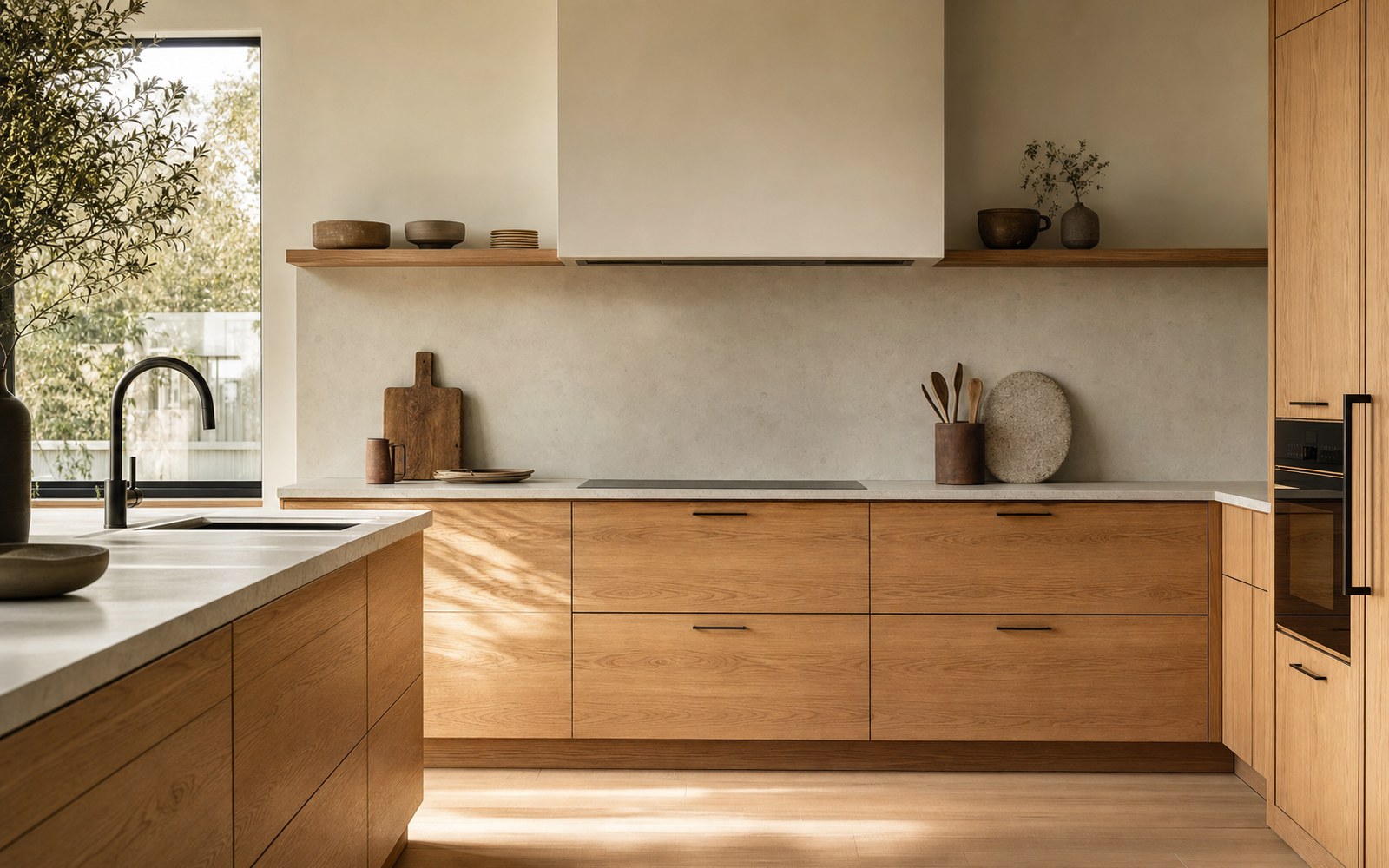
The most actively specified style in NSW in 2026. Handleless or finger-pull cabinetry, warm neutral colours, textured surfaces, and a contrast between painted lowers and a timber-look upper. This is exactly where Polytec SYNC earns its reputation: the SYNC Classic Oak or Natural Walnut upper cabinets against a 2-pac matt Dulux Rockpool or Antique White lower creates the warm-cold-warm-cool contrast that defines the look. Alternatively, a full-run Polytec SYNC kitchen with a textured stone benchtop reads as coherent and warm without the complexity of managing two finish types.
Industrial
Raw textures, darker tones, black or gunmetal hardware (Häfele or Blum Legrabox in Carbon Black), and often a mix of open shelving with closed cabinetry. 2-pac in a deep matte — charcoal, dark forest green, or near-black — is the typical finish. Timber veneer is sometimes used for the open shelf decks. This style suits the inner-Newcastle terrace conversions we see in Cooks Hill, The Junction, and Hamilton North.
Heritage
Heritage kitchens in Newcastle's federation and inter-war housing stock require period-appropriate proportions and materials — shaker profiles, beaded-inset detail, painted finishes in heritage tones. 2-pac on MR board in soft heritage tones (Dulux Heritage Collection equivalents) is the correct approach for painted heritage joinery. For clients who want exposed timber, Blackbutt or Spotted Gum veneer honours the species that would have been used in the original construction.
What SteepWood specifies and why
We are a custom joinery studio, not a laminate dealer or a paint supplier. We do not have a commercial relationship with any finish manufacturer, which means our recommendations are based purely on performance and fit.
In a typical year, our kitchen joinery splits roughly as follows by finish type:
- 2-pac matt or satin: approximately 55% of kitchen door orders. This is our most commonly specified finish. For clients building a kitchen they intend to use for 15+ years in an owner-occupied home, 2-pac on MR board is the best whole-of-life investment in finish quality.
- Polytec laminate (primarily SYNC woodgrain): approximately 30%. For clients who want the warmth of a timber-look finish without the cost of genuine veneer, or who have a tighter budget, SYNC on MR board is what we specify. We do not use Polytec in lieu of a client wanting solid colour 2-pac — but for the woodgrain look, SYNC is genuinely compelling.
- Timber veneer: approximately 12%. For clients who want genuine character and are prepared for the additional cost and maintenance considerations. Most commonly specified for island panels, feature cabinet runs, and heritage properties.
- Solid timber: under 5%. Heritage joinery, bespoke furniture-grade pieces, and specific commission work.
We do not specify standard particleboard substrate for any kitchen, and we do not use low-cost laminates outside the Polytec and Laminex commercial ranges. These are not upsells — they are the minimum standard required to produce work we are prepared to warranty.
All SteepWood joinery carries a 10-year structural warranty (Lic. 489553C). When we specify a finish for your kitchen, we are specifying something we expect to stand behind for a decade.
Frequently asked questions
Is 2-pac worth the extra cost over laminate?
For most kitchens, yes — if budget allows. 2-pac gives you a seamless painted finish with no visible substrate join, superior scratch resistance on MR board, and a far wider colour range including custom colours matched to any Dulux or Wattyl chip. The premium over laminate is roughly $100–$200 per door. If you are fitting out a high-use family kitchen that you intend to keep for 15+ years, 2-pac earns its cost. For a rental property, investment kitchen, or a project where the cabinetry is largely concealed behind appliances and pantry doors, high-quality Polytec laminate is a sound and honest alternative.
Will Polytec laminate look cheap in 10 years?
Not if you specify the right range. Polytec SYNC textured woodgrain doors, in particular, have a physical texture pressed into the surface that does not fade the same way a flat gloss laminate does. The risk of laminate looking dated comes from choosing high-gloss white finishes that show every fingerprint and scratch from day one. Matt-finish and woodgrain laminates age far more gracefully. The Laminex Woodmatt range has proven durable across many Australian kitchens installed in the early 2010s. Choose texture and matt over flat gloss and you will not have regrets at the ten-year mark.
What is the best finish for a coastal home in NSW?
For kitchens and laundry cabinetry in coastal NSW environments — Newcastle, the Central Coast, Lake Macquarie, Byron Bay, Port Macquarie — we recommend 2-pac on MR board as the gold standard. The polyurethane film is non-porous, does not absorb salt-laden air, and resists the humidity cycling that causes edge-swelling in standard particleboard. If budget favours laminate, Polytec SYNC on MR board substrate is a sound alternative. Avoid standard particleboard substrate anywhere within 5 km of the coast. Timber veneer is beautiful but requires a sealed or lacquered topcoat to perform reliably; oiled finishes are not recommended for coastal kitchens.
Can I mix finishes in one kitchen?
Yes, and in 2026 this is one of the most commonly specified approaches in NSW. A typical mixed-finish brief might pair Polytec SYNC Classic Oak upper cabinets with a 2-pac matt base in a deep olive or navy, or combine a timber veneer island with painted perimeter cabinetry. The rule we apply is: mix no more than two finish types per kitchen and ensure they share at least one tone — warm-to-warm or cool-to-cool. Mixing a cold white 2-pac upper with a warm Blackbutt veneer lower works because the contrast is intentional and large enough to read as deliberate design rather than inconsistency.
Does timber veneer work in laundries and bathrooms?
Timber veneer can work in laundries and bathrooms when correctly specified, but it requires extra care. The veneer facing must be sealed with a two-pack lacquer or polyurethane topcoat — not oil, not wax. The substrate must be MR board or marine ply. Door construction must be fully edge-banded with a compatible PVC or timber edge to prevent moisture entry at the board perimeter. Under these conditions we have installed timber veneer laundry cabinets and custom bathroom vanity joinery across coastal NSW that have performed well for many years. Where a client wants the warmth of timber in a wet area but is cautious about maintenance, Polytec SYNC woodgrain laminate on MR board gives almost identical visual results with considerably less ongoing care.
If you are at the stage of choosing a kitchen finish and want a direct recommendation based on your home, your location, and your brief, we offer a free in-home measure and quote across all of NSW and ACT. Call 0468 387 676 (Mon–Fri 7am–5pm, Sat by appointment), email hello@steepwood.com.au, or use the form at /quote to start the conversation. Our Newcastle workshop builds every piece of custom kitchen joinery we supply — no outsourced flat-pack assembly, no interstate freight delays — and we stand behind all structural work with a 10-year warranty (NSW Carpentry Contractor Licence 489553C).