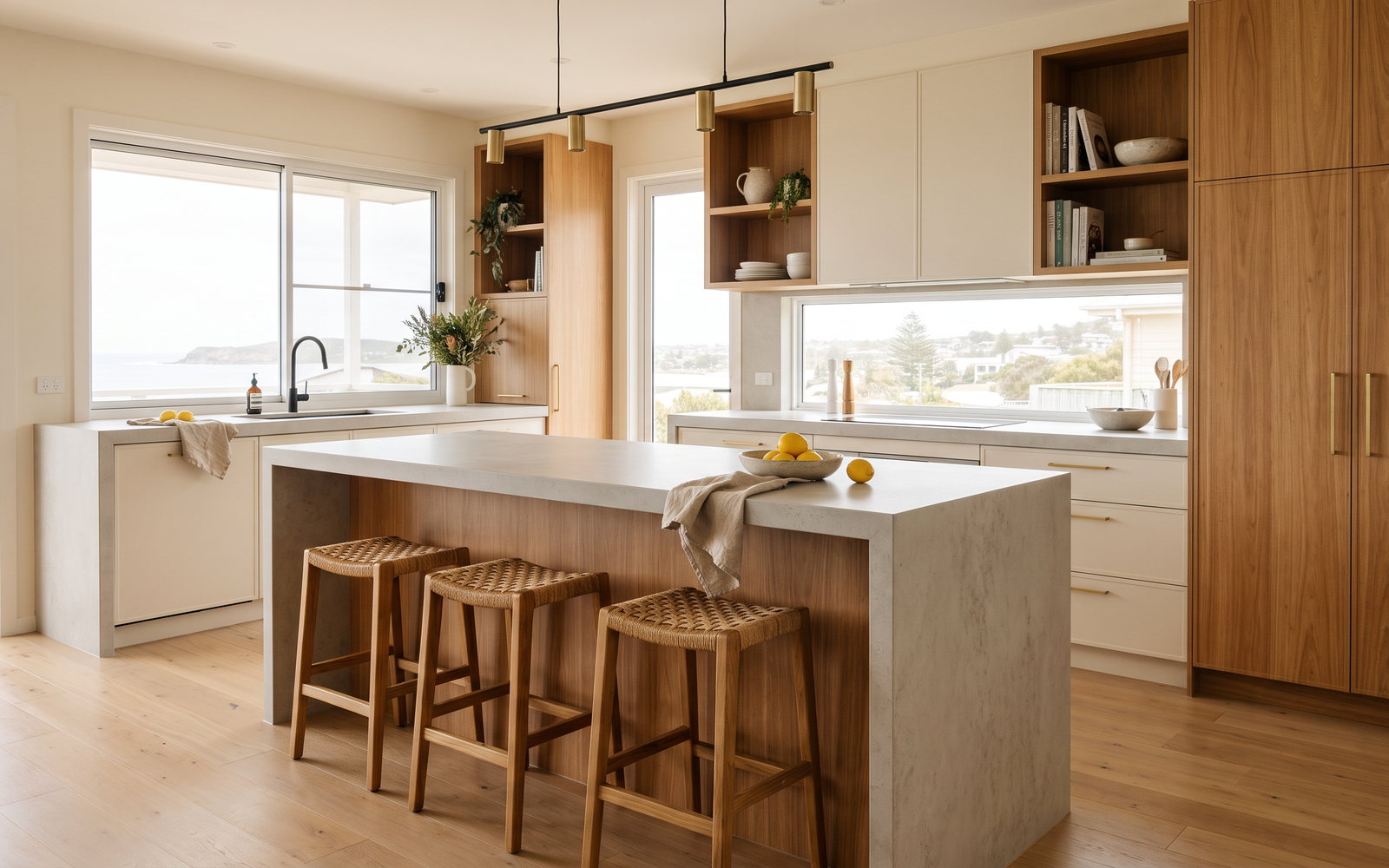
Porcelain benchtop cost in NSW is commonly an indicative 2026 range of $900 to $1,400 per linear metre installed for Dekton, Neolith-style porcelain and sintered stone work, before unusual slab yield, waterfall ends and complex access are allowed for (Konnect Kitchens). That range is not a fixed quote. A 4.2 metre galley can use a slab efficiently; a small waterfall island can consume material and fabrication out of proportion to its bench length.
This is the pricing companion to our engineered-stone alternatives guide. The regulation matters, but once you know porcelain and resin-free sintered stone are permitted, the useful question is what the installed surface will cost and why.
The short answer
Porcelain and sintered stone are premium, post-ban surface choices. Market guidance places installed porcelain and sintered stone at $900–$1,400 per linear metre, while historic engineered-stone market ranges were $450–$1,200 (Konnect Kitchens). The national average kitchen renovation is reported at $42,630, so the benchtop decision needs to be priced as a distinct package rather than swallowed by a kitchen total (Hacker Australia).
| Material | Indicative installed range per linear metre | Typical use |
|---|---|---|
| Laminate | $150–$350 | Budget and utility runs |
| Porcelain or sintered stone | $900–$1,400 | Kitchens, islands and premium laundries |
| Natural stone | $900–$2,500 | Character-led and premium work |
What porcelain and sintered stone actually are
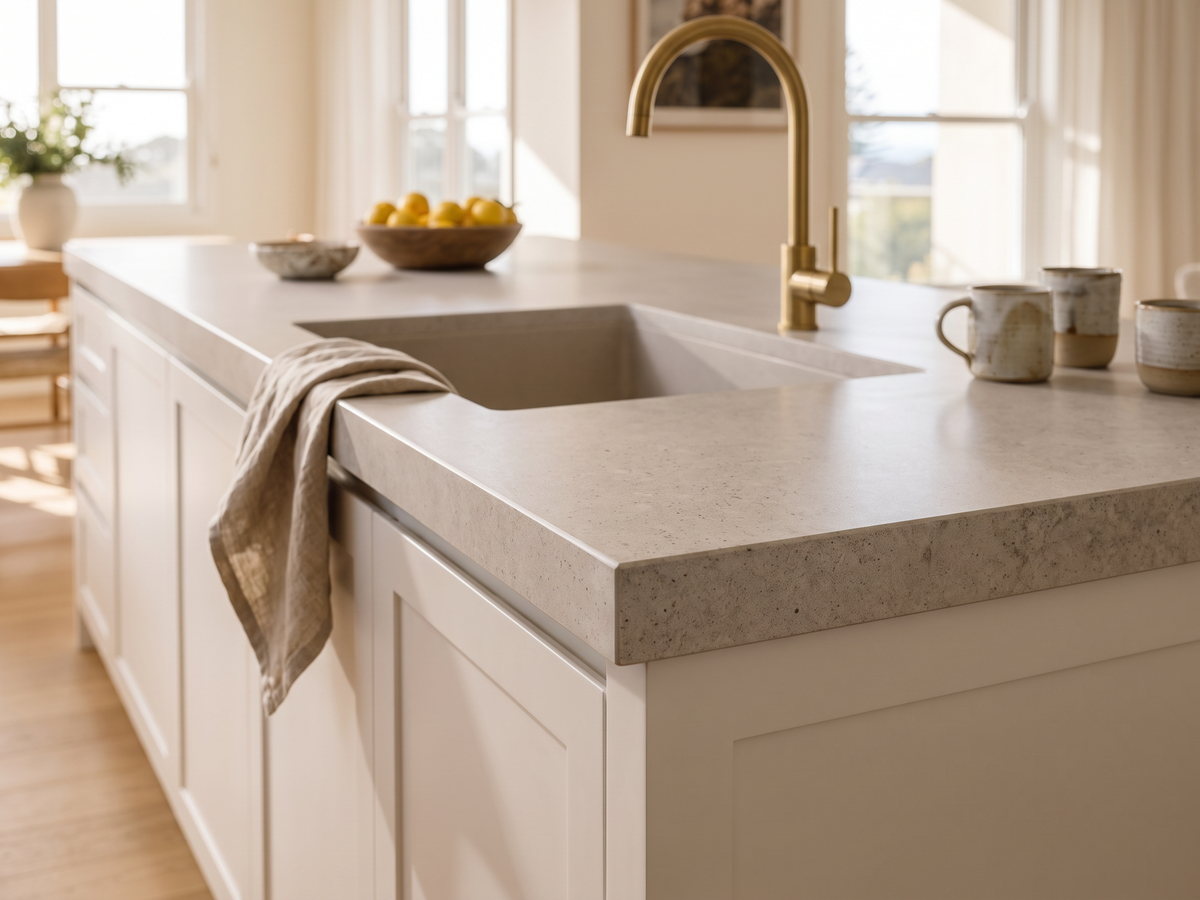
Porcelain and sintered stone are dense manufactured slab surfaces. The distinction that matters to a homeowner is the selected product’s composition, thickness, fabrication instructions and suitability for the planned edge and cut-outs. The number is useful only if the specification underneath it is visible. In workshop terms, we check the material, the edges, the joinery construction, the hardware and the installation route before comparing one price with another. A low allowance can be appropriate for a simple brief; it becomes misleading when it quietly excludes the element that makes the room function.
This is where people waste money: choosing the feature before checking the interface. A porcelain benchtop has to work with walls that are not always square, services that must remain accessible and appliances or surfaces that have their own installation requirements. Put those constraints on the drawing early. It gives the fabricator a stable brief and gives the homeowner a quote that can be compared line by line.
A sensible decision is not always the most expensive one. Keep the budget on the parts you touch, see and rely on every day, then simplify the concealed parts where that does not shorten the life of the work. Ask for the excluded work in writing, retain samples and drawings, and approve a variation before the material is cut.
Why they are still legal in NSW
Engineered stone containing at least 1% crystalline silica has been prohibited in NSW since 1 July 2024. SafeWork NSW says porcelain without resin and sintered stone without resin are not included in that engineered-stone definition (SafeWork NSW). The number is useful only if the specification underneath it is visible. In workshop terms, we check the material, the edges, the joinery construction, the hardware and the installation route before comparing one price with another. A low allowance can be appropriate for a simple brief; it becomes misleading when it quietly excludes the element that makes the room function.
This is where people waste money: choosing the feature before checking the interface. A porcelain benchtop has to work with walls that are not always square, services that must remain accessible and appliances or surfaces that have their own installation requirements. Put those constraints on the drawing early. It gives the fabricator a stable brief and gives the homeowner a quote that can be compared line by line.
A sensible decision is not always the most expensive one. Keep the budget on the parts you touch, see and rely on every day, then simplify the concealed parts where that does not shorten the life of the work. Ask for the excluded work in writing, retain samples and drawings, and approve a variation before the material is cut.
Installed price per linear metre, by material
Use a linear-metre figure only as a first budget check. It needs to be reconciled with slab width, joins, ends and fabrication. The $900–$1,400 band applies as an installed planning range, not a brand price (Konnect Kitchens). The number is useful only if the specification underneath it is visible. In workshop terms, we check the material, the edges, the joinery construction, the hardware and the installation route before comparing one price with another. A low allowance can be appropriate for a simple brief; it becomes misleading when it quietly excludes the element that makes the room function.
This is where people waste money: choosing the feature before checking the interface. A porcelain benchtop has to work with walls that are not always square, services that must remain accessible and appliances or surfaces that have their own installation requirements. Put those constraints on the drawing early. It gives the fabricator a stable brief and gives the homeowner a quote that can be compared line by line.
A sensible decision is not always the most expensive one. Keep the budget on the parts you touch, see and rely on every day, then simplify the concealed parts where that does not shorten the life of the work. Ask for the excluded work in writing, retain samples and drawings, and approve a variation before the material is cut.
What the fabrication line items are (cutting, mitred edges, waterfall ends, cutouts, splashbacks)
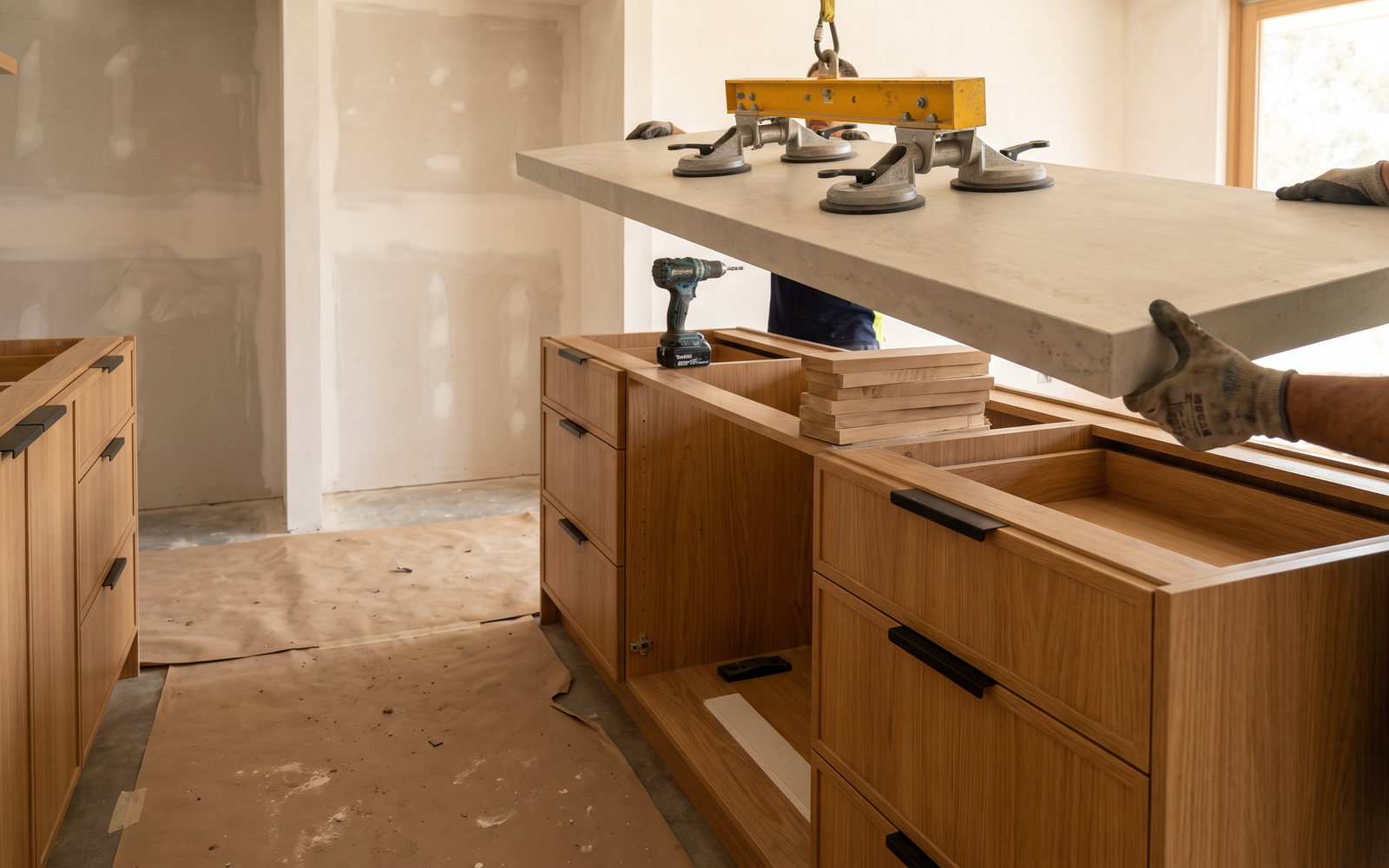
The fabrication price is where a simple slab becomes a finished benchtop. Straight cuts are different work from a mitred edge, an undermount sink cut-out, a cooktop opening, a waterfall end or a matching splashback. The number is useful only if the specification underneath it is visible. In workshop terms, we check the material, the edges, the joinery construction, the hardware and the installation route before comparing one price with another. A low allowance can be appropriate for a simple brief; it becomes misleading when it quietly excludes the element that makes the room function.
This is where people waste money: choosing the feature before checking the interface. A porcelain benchtop has to work with walls that are not always square, services that must remain accessible and appliances or surfaces that have their own installation requirements. Put those constraints on the drawing early. It gives the fabricator a stable brief and gives the homeowner a quote that can be compared line by line.
A sensible decision is not always the most expensive one. Keep the budget on the parts you touch, see and rely on every day, then simplify the concealed parts where that does not shorten the life of the work. Ask for the excluded work in writing, retain samples and drawings, and approve a variation before the material is cut.
STEEPWOOD CUSTOM KITCHEN JOINERY — Benchtop pricing becomes clear once the layout, slab yield, cut-outs and edge profile are documented. Get a free measure and quote before committing to a slab.
Thickness, and what 12 mm versus 20 mm costs
Thickness changes appearance, handling and edge design. A 12 mm slab can create a fine contemporary line. A 20 mm presentation or built-up edge may need more material and a different fabrication approach. Ask for the edge detail on the drawing. The number is useful only if the specification underneath it is visible. In workshop terms, we check the material, the edges, the joinery construction, the hardware and the installation route before comparing one price with another. A low allowance can be appropriate for a simple brief; it becomes misleading when it quietly excludes the element that makes the room function.
This is where people waste money: choosing the feature before checking the interface. A porcelain benchtop has to work with walls that are not always square, services that must remain accessible and appliances or surfaces that have their own installation requirements. Put those constraints on the drawing early. It gives the fabricator a stable brief and gives the homeowner a quote that can be compared line by line.
A sensible decision is not always the most expensive one. Keep the budget on the parts you touch, see and rely on every day, then simplify the concealed parts where that does not shorten the life of the work. Ask for the excluded work in writing, retain samples and drawings, and approve a variation before the material is cut.
Where porcelain wins and where it loses
Porcelain can be a strong choice for heat, scratch and UV resistance in an appropriate product specification. It loses where a client expects it to behave like an impact-proof solid block or where a thin exposed edge is poorly supported. The number is useful only if the specification underneath it is visible. In workshop terms, we check the material, the edges, the joinery construction, the hardware and the installation route before comparing one price with another. A low allowance can be appropriate for a simple brief; it becomes misleading when it quietly excludes the element that makes the room function.
This is where people waste money: choosing the feature before checking the interface. A porcelain benchtop has to work with walls that are not always square, services that must remain accessible and appliances or surfaces that have their own installation requirements. Put those constraints on the drawing early. It gives the fabricator a stable brief and gives the homeowner a quote that can be compared line by line.
A sensible decision is not always the most expensive one. Keep the budget on the parts you touch, see and rely on every day, then simplify the concealed parts where that does not shorten the life of the work. Ask for the excluded work in writing, retain samples and drawings, and approve a variation before the material is cut.
Wastage and slab yield, the number nobody explains
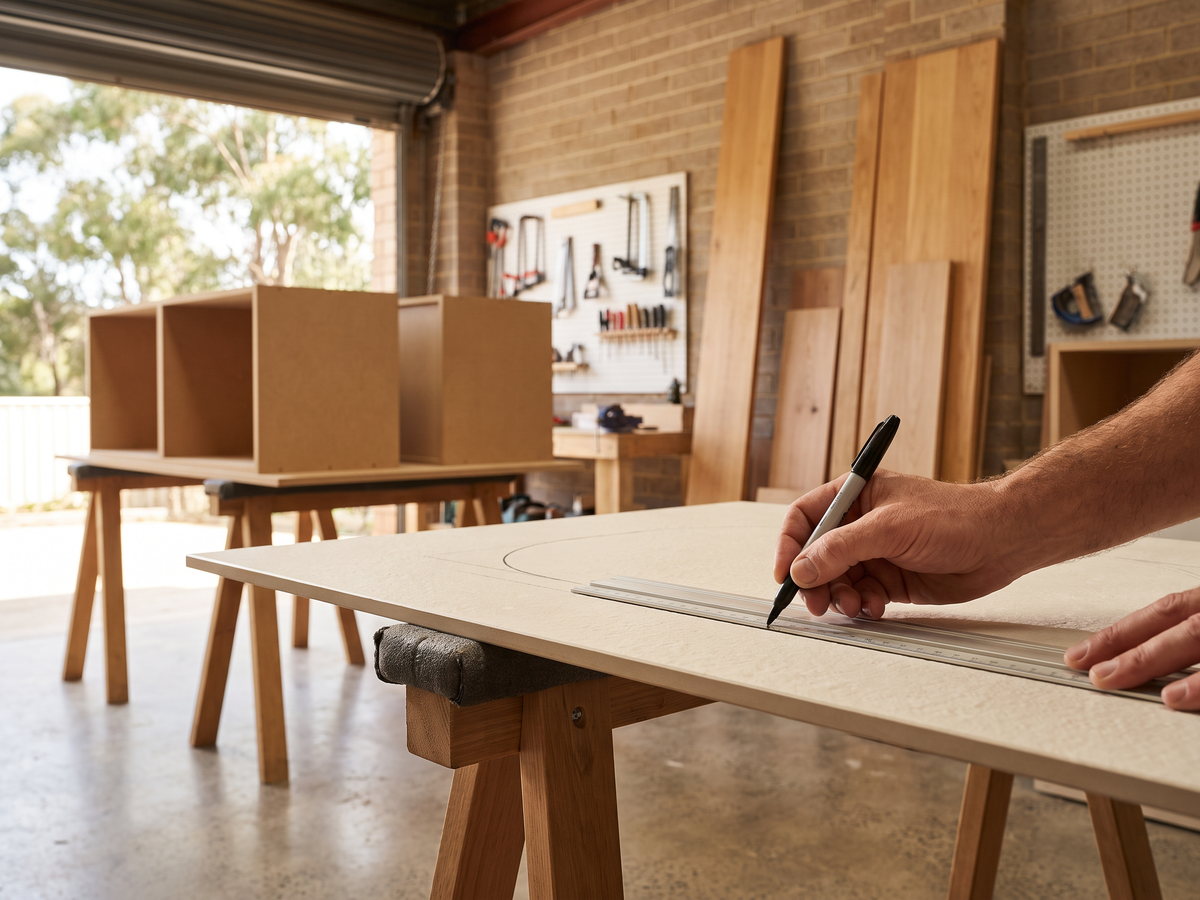
Slabs arrive in fixed dimensions. The layout, vein direction, cut-outs and visible ends decide how much of that slab becomes the final bench. A short island with two waterfall legs can have poor yield even though its measured bench length looks small. The number is useful only if the specification underneath it is visible. In workshop terms, we check the material, the edges, the joinery construction, the hardware and the installation route before comparing one price with another. A low allowance can be appropriate for a simple brief; it becomes misleading when it quietly excludes the element that makes the room function.
This is where people waste money: choosing the feature before checking the interface. A porcelain benchtop has to work with walls that are not always square, services that must remain accessible and appliances or surfaces that have their own installation requirements. Put those constraints on the drawing early. It gives the fabricator a stable brief and gives the homeowner a quote that can be compared line by line.
A sensible decision is not always the most expensive one. Keep the budget on the parts you touch, see and rely on every day, then simplify the concealed parts where that does not shorten the life of the work. Ask for the excluded work in writing, retain samples and drawings, and approve a variation before the material is cut.
Costing three real benchtop layouts
| Layout | Scope | Indicative 2026 installed allowance including GST |
|---|---|---|
| Galley | 4.2 lm, straight runs and standard cut-outs | $3,800–$6,800 |
| Island plus perimeter | 7 lm, multiple joins and appliance cut-outs | $6,300–$11,500 |
| Waterfall island | 3.6 lm island with waterfall ends | $5,000–$10,000+ |
The following allowances include GST and describe surfaces only, not cabinetry, appliances or unrelated trades. The actual material selection and site measure decide the quote. The number is useful only if the specification underneath it is visible. In workshop terms, we check the material, the edges, the joinery construction, the hardware and the installation route before comparing one price with another. A low allowance can be appropriate for a simple brief; it becomes misleading when it quietly excludes the element that makes the room function.
This is where people waste money: choosing the feature before checking the interface. A porcelain benchtop has to work with walls that are not always square, services that must remain accessible and appliances or surfaces that have their own installation requirements. Put those constraints on the drawing early. It gives the fabricator a stable brief and gives the homeowner a quote that can be compared line by line.
A sensible decision is not always the most expensive one. Keep the budget on the parts you touch, see and rely on every day, then simplify the concealed parts where that does not shorten the life of the work. Ask for the excluded work in writing, retain samples and drawings, and approve a variation before the material is cut.
Benchtop pricing across NSW
| NSW region | Typical benchtop selection and delivery consideration |
|---|---|
| Newcastle | $115.526 million of approved alterations in 2025–26; local measure and coastal material selection matter (ABS building approvals data) |
| Central Coast | Large regional dwelling base; allow for family storage and coastal delivery (ABS building approvals data) |
| Lake Macquarie | $92.577 million of approved alterations; older rooms often need careful site measure (ABS building approvals data) |
| Northern Beaches | $414.629 million of alterations; access and premium specification need early planning (ABS building approvals data) |
| Inner West | $300.441 million of alterations; terrace widths and site access shape the installation (ABS building approvals data) |
| City of Sydney | Apartment-heavy stock makes strata access and delivery booking material (ABS building approvals data) |
| Wollongong | $117.062 million of alterations; coastal handling and staged live-in work are common (ABS building approvals data) |
| Blue Mountains | Separate houses are 92.1% of housing stock; access and existing-house geometry matter (ABS Census) |
| For a complete kitchen package, compare the surface allowance beside custom kitchen joinery, not after the cabinets are approved. Consumer prices should be shown as a total including GST, which is why the consumer ranges in this guide are GST-inclusive (business.gov.au). |
For related decisions, compare custom kitchen joinery with a custom bathroom vanity, then read the NSW kitchen cost guide and laundry joinery cost guide. We service Newcastle and Sydney; the final scope is confirmed through a free measure and quote.
SteepWood is Pavit Cabinetry Pty Ltd trading as SteepWood, NSW Carpentry Contractor Licence 489553C, ABN 52 697 313 269. NSW requires a licence for residential building work above $5,000 including GST; work above $20,000 follows the larger contract and Home Building Compensation pathway where applicable (NSW Government contract guidance).
FAQ
How much is a porcelain benchtop in NSW?
Installed porcelain and sintered stone benchtops in NSW are commonly allowed at about $900 to $1,400 per linear metre, but the total depends on slab yield, cut-outs, edge detail and access. The useful next step is a measured layout and a written inclusion list, rather than selecting from a generic rate alone.
Is porcelain banned like engineered stone?
No. Porcelain without resin and sintered stone without resin are outside the engineered-stone definition used in the NSW prohibition; verify the selected product and fabrication method with the supplier. The useful next step is a measured layout and a written inclusion list, rather than selecting from a generic rate alone.
Is porcelain or sintered stone stronger?
Neither label alone settles the question. Compare the actual product’s thickness, edge treatment, substrate support, fabrication guidance and intended use rather than relying on a showroom description. The useful next step is a measured layout and a written inclusion list, rather than selecting from a generic rate alone.
Can porcelain chip on the edge?
Yes. Porcelain can chip, especially at exposed edges or where an unsupported impact occurs. Choose an edge detail suitable for the slab, and do not treat a thin premium surface like a solid timber workbench. The useful next step is a measured layout and a written inclusion list, rather than selecting from a generic rate alone.
What thickness should I choose?
Choose thickness with the edge profile, cabinetry support, appliance cut-outs and visual brief. A thinner slab can look sharp, while a thicker built-up edge can add a stronger visual line and more fabrication labour. The useful next step is a measured layout and a written inclusion list, rather than selecting from a generic rate alone.
Is porcelain cheaper than natural stone?
Porcelain may be cheaper or dearer than a natural stone selection depending on slab size, yield, edge work and fabrication. Compare installed totals and exclusions, not a material label or a square-metre showroom price. The useful next step is a measured layout and a written inclusion list, rather than selecting from a generic rate alone.
STEEPWOOD CUSTOM KITCHEN JOINERY — Choose the slab after the cabinet layout, edge profile and access route are clear. Get a free measure and quote for an itemised joinery scope.