A custom timber furniture cost in Australia starts around $3,500 including GST for a made-to-measure hardwood dining table and can pass $15,000 including GST for a large table, matching bench or a fully specified set. That range is broad because furniture is not priced by a photograph. The maker is pricing timber selection, construction, finishing, handling and the way the finished piece gets into your home.
A retail table and a workshop-built table answer different questions. Retail spreads a fixed design across volume. A custom piece has to fit your room, chairs, family and material preference from the beginning. That does not make custom right for every purchase. It makes the details worth understanding before a quote arrives.
The short answer
| Piece | Typical scope | Indicative GST-inclusive price band |
|---|---|---|
| Dining table | hardwood top and base | $3,500–$12,000 |
| Matching bench | hardwood seat and base | $1,500–$4,500 |
| Sideboard or buffet | doors, drawers and internal storage | $4,000–$12,000 |
| Bed frame and bedhead | bespoke timber structure | $4,000–$12,000 |
These are indicative planning bands, not fixed offers. Material, scale and freight need a written scope.
How a maker actually prices a piece: material, hours, finish, freight
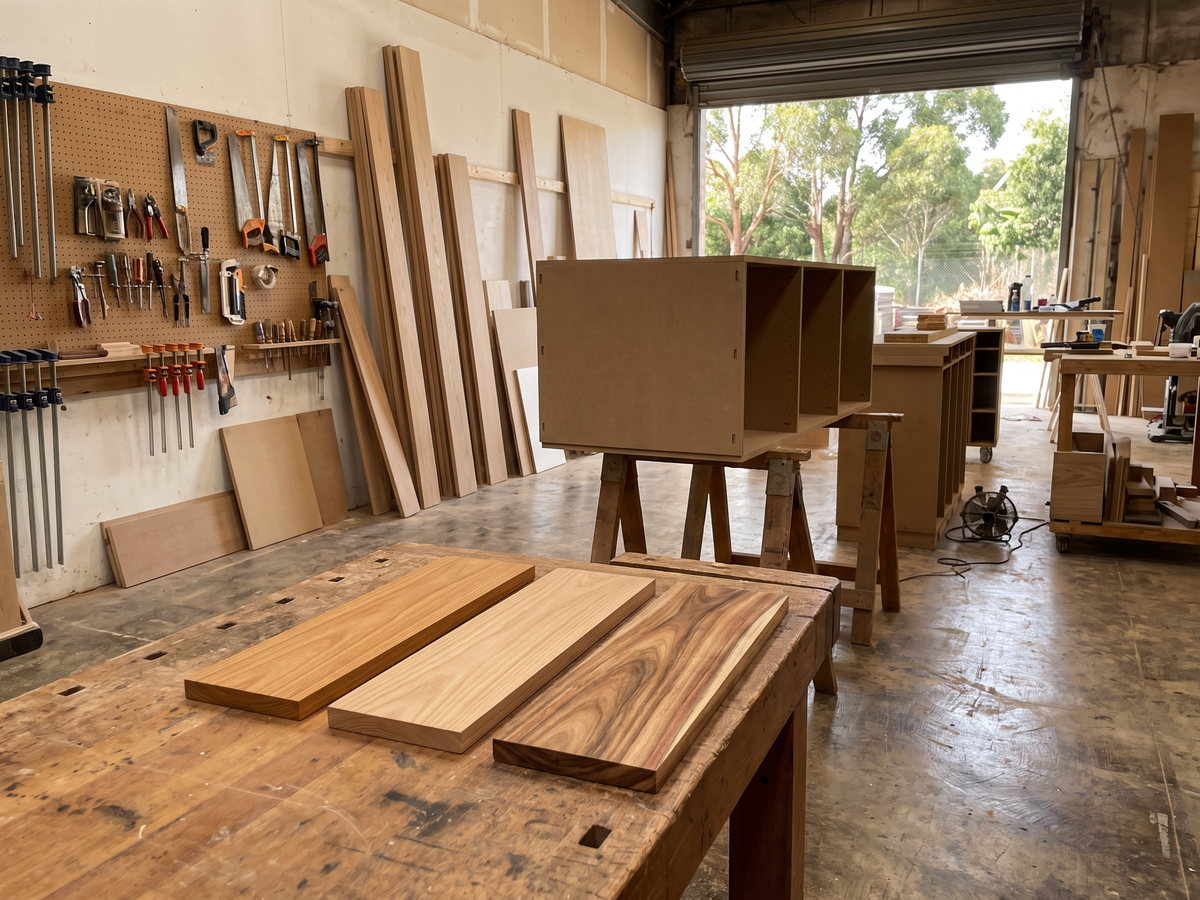
Timber rates demonstrate why species matters, but do not price the furniture alone. In August 2026, dressed Spotted Gum was listed at $44.00 per linear metre ex-GST, Blackbutt at $39.50, Tasmanian Oak at $30.25 and American White Oak at $30.55. A dining table needs selected, machined stock rather than a single length from a rack.
A specialist joinery charge-out of $120 or more per hour covers workshop overhead, machinery, consumables, insurance, design, finishing and business risk as well as hands-on time. Ask for the construction and finish in the quote; do not reduce a piece to a timber price.
Dining tables, priced by size and species
A dining table is priced from the finished dimensions out. A 2.4 m top consumes more timber, machining, flattening, sanding and finish work than a small round table, and the base must manage its weight. Tables also need a practical edge, leg positions that suit chairs and an under-frame that allows the top to move.
The useful conversation is specific: finished dimensions, species or acceptable substitutes, edge profile, base, joint type, sheen, delivery path and care expectations. Changing any one of those after timber is ordered can change both the programme and price. A clear approval point before manufacture protects the buyer and the maker.
Benches, sideboards and buffets
Benches are not simply half a table. They need long-grain structure, stable legs and a seat that does not rack when people slide along it. Sideboards and buffets add carcasses, doors, drawers, back panels and installation-level fitting, so their price follows moving parts and interiors as well as timber face area.
The useful conversation is specific: finished dimensions, species or acceptable substitutes, edge profile, base, joint type, sheen, delivery path and care expectations. Changing any one of those after timber is ordered can change both the programme and price. A clear approval point before manufacture protects the buyer and the maker.
Beds and bedheads
A bed frame must carry dynamic load without loosening, and it must arrive in a room through real doors and stairs. Slatted bases, centre rails, removable side rails and headboard fixing are design decisions. A bedhead can be a simple timber panel, a storage wall or an upholstered element coordinated with another trade.
The useful conversation is specific: finished dimensions, species or acceptable substitutes, edge profile, base, joint type, sheen, delivery path and care expectations. Changing any one of those after timber is ordered can change both the programme and price. A clear approval point before manufacture protects the buyer and the maker.
Desks and consoles
A desk needs cable access, leg clearance and a top that stays flat through seasonal change. A console is often narrow but not cheap: it still needs a stable base, a finished rear edge and careful handling because long, slender pieces can rack. Decide whether drawers, a cable void or wall fixing are required before pricing.
The useful conversation is specific: finished dimensions, species or acceptable substitutes, edge profile, base, joint type, sheen, delivery path and care expectations. Changing any one of those after timber is ordered can change both the programme and price. A clear approval point before manufacture protects the buyer and the maker.
Joints, and why a mortise and tenon costs more than a dowel
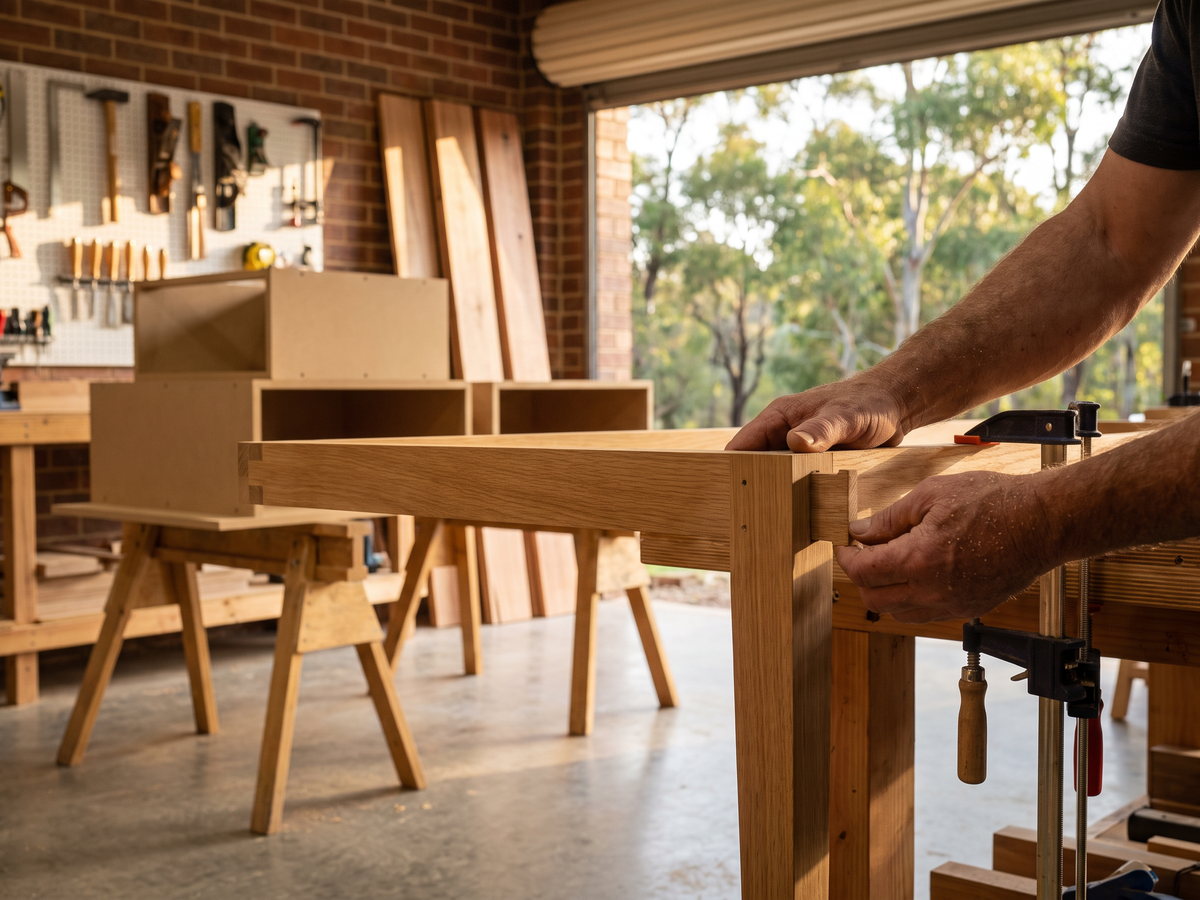
Joinery labour is visible in the construction even when the joint is concealed. A mortise and tenon involves accurately cutting and fitting members so the frame carries load mechanically; a dowelled joint can be efficient in the right setting but is faster to produce. Neither is a badge on its own: the correct joint follows the member, load and design.
The useful conversation is specific: finished dimensions, species or acceptable substitutes, edge profile, base, joint type, sheen, delivery path and care expectations. Changing any one of those after timber is ordered can change both the programme and price. A clear approval point before manufacture protects the buyer and the maker.
Finishes: oil, hardwax, lacquer and two-pack
Finish changes both labour and maintenance. Oil and hardwax finishes can give timber a natural feel and permit local maintenance, while lacquer and two-pack create more continuous protection and a different sheen. The finish should be sampled on the chosen timber because grain and colour shift after coating.
The useful conversation is specific: finished dimensions, species or acceptable substitutes, edge profile, base, joint type, sheen, delivery path and care expectations. Changing any one of those after timber is ordered can change both the programme and price. A clear approval point before manufacture protects the buyer and the maker.
Timber movement, breadboard ends and the details that stop a table cupping
Solid wood changes across the grain as humidity changes. That is normal material behaviour, not a defect to be defeated with screws. Breadboard ends, elongated fixing slots and sensible board orientation give a broad top room to move while keeping it flat. Furniture is designed to accommodate movement, then kept away from direct heat and wet cleaning.
The useful conversation is specific: finished dimensions, species or acceptable substitutes, edge profile, base, joint type, sheen, delivery path and care expectations. Changing any one of those after timber is ordered can change both the programme and price. A clear approval point before manufacture protects the buyer and the maker.
Lead times and freight across Australia
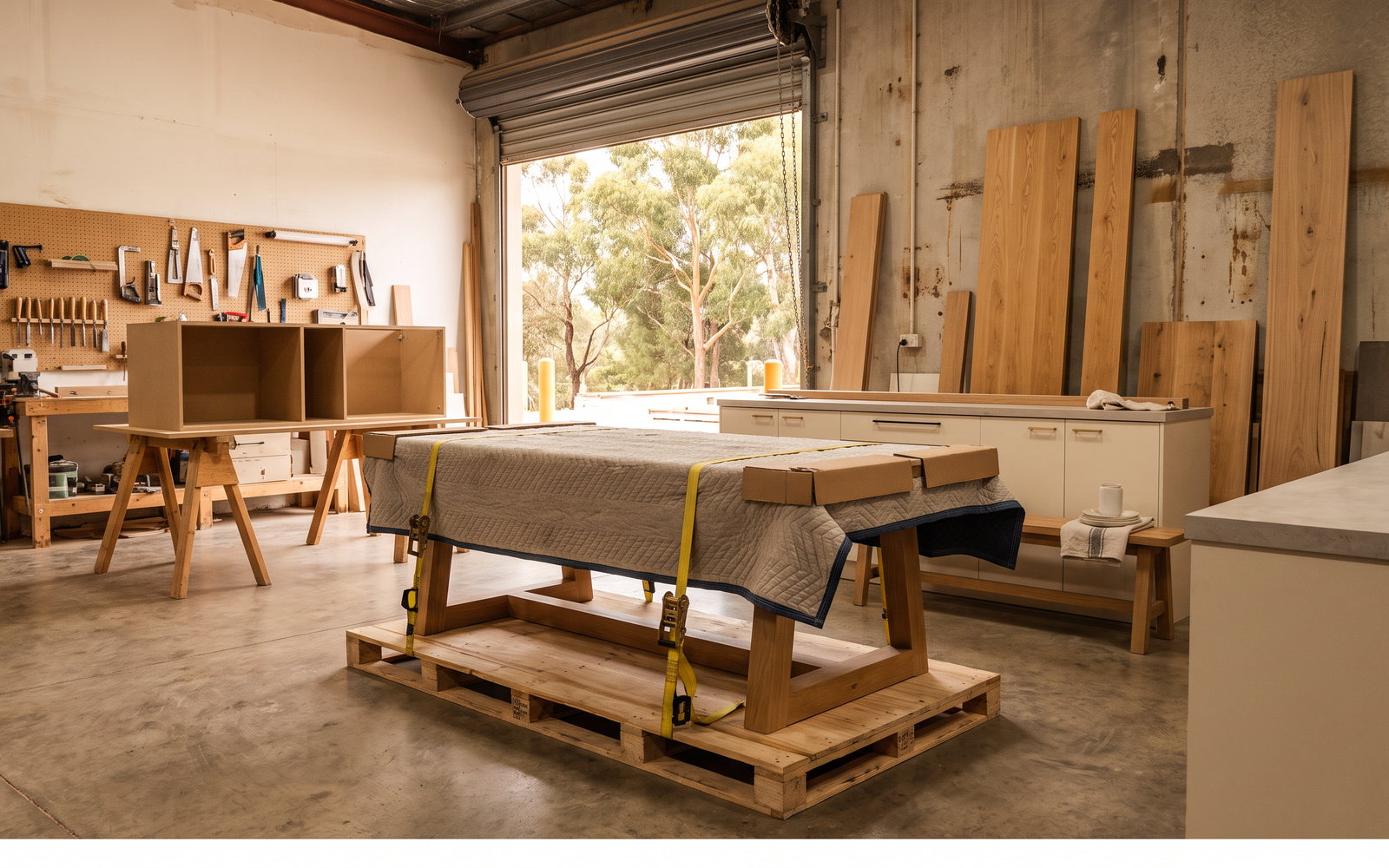
A furniture programme begins after design approval and timber selection, then runs through machining, assembly, finishing, curing, packing and transport. Freight is a separate risk point: a beautiful table needs edge protection, a planned lift path and an adult receiving arrangement. The service model matters as much as the destination postcode.
The useful conversation is specific: finished dimensions, species or acceptable substitutes, edge profile, base, joint type, sheen, delivery path and care expectations. Changing any one of those after timber is ordered can change both the programme and price. A clear approval point before manufacture protects the buyer and the maker.
What the same table costs in three species
Species price is one input, not the whole bill. A maker still needs to select boards, allow for defects, mill stock, construct the base, sand, finish and transport the piece. Use a species comparison to identify a direction, then obtain a written quote for the finished table rather than multiplying a retail timber rate by a table length.
The useful conversation is specific: finished dimensions, species or acceptable substitutes, edge profile, base, joint type, sheen, delivery path and care expectations. Changing any one of those after timber is ordered can change both the programme and price. A clear approval point before manufacture protects the buyer and the maker.
STEEPWOOD CUSTOM FURNITURE — We build furniture as a measured piece of joinery, with the timber, construction and delivery basis stated before manufacture. Get a free measure and quote for a piece made in our Newcastle workshop.
What a complete furniture quote should contain
A useful furniture quote names the finished item, not just the broad category. “Oak table” leaves open every cost driver: whether the top is solid or veneer, its finished length and width, the thickness, edge profile, base construction, colour, sheen, seats it is designed around and whether the base can be removed for delivery. The drawings do not need to be theatrical. A dimensioned plan, elevation and material schedule usually tell a buyer far more than a polished render.
The timber should be identified as a species and construction, with an agreed tolerance for natural variation. Solid boards can contain gum vein, colour change and figure; that is part of their character, but the client and maker should agree whether a very uniform look or a more expressive selection is wanted. Veneer is not a lesser material when it is correctly specified. It can deliver grain continuity and stability across a large sideboard or cabinet door, where wide solid boards would need a different construction.
Delivery is part of the scope. Confirm the street access, parking, stairs, lift, corridor turns, doors and who will receive the item. A long table may need a removable base or an alternate route; a tall sideboard may need feet fitted after it enters the room. That consideration prevents a finished piece becoming a site problem. It is also why a made-to-measure table can be the more economical outcome over its life: it is designed for the actual room, rather than forced into it.
Care is part of the construction
Timber furniture needs ordinary, not precious, care. Wipe spills promptly, use placemats under hot or wet items, and avoid leaving a wet cloth or planter in one position. Strong household cleaners and prolonged direct heat can affect a finish, whatever the timber species. The manufacturer’s care instructions should match the finish selected, particularly for oil and hardwax systems that can be maintained differently from a lacquered surface.
Do not judge a table straight after a long freight trip or a dramatic seasonal weather change. Give it time to settle in a stable indoor environment. If a concern appears, photograph it, keep the room conditions sensible and speak with the maker before applying a repair product. The wrong repair can turn a small mark into a large refinishing job. This is not an argument against solid timber; it is the normal responsibility that comes with a responsive natural material.
Choosing between custom and retail
Retail furniture is often the sensible answer for a temporary room, a tight budget or a piece that does not need to fit a particular space. Custom earns its cost where dimensions are awkward, the piece needs to match existing joinery, the timber choice matters, or the furniture will be used heavily for many years. The buyer should not apologise for choosing either path.
If commissioning a piece, avoid changing its scale after the maker has prepared a drawing. A 100 mm increase in length can alter timber yield, handling, base geometry and freight class. It can be a worthwhile change, but it is not a cosmetic note. Compare quotations on finished dimensions, construction and delivery, then select the scope that genuinely suits the home rather than the lowest incomplete figure.
A final sample sign-off is worth the time. View the timber and finish beside the existing floor, paint and upholstery in normal light. It is easier to agree the warmth, grain and sheen before the finish is applied than to debate a completed table after delivery.
Dimensions should include the chairs, circulation and table extension, not just the empty tabletop. Measure the room after allowing the dining chairs to pull out.
That small check avoids a finished piece that is beautiful but awkward to live around every day.
Plan for chairs, rugs and door swings too.
NSW furniture demand and interstate freight
The following locations show why a furniture brief needs both a workshop and delivery plan. Alterations approvals are ABS 2025–26 figures, included as renovation context rather than a price loading.
| Market | Alterations approved | Furniture context | Freight note |
|---|---|---|---|
| Newcastle | $115.5 million | Direct workshop measure and delivery | Access confirmed at quote |
| Central Coast | $166.0 million | Coastal renovation furniture | Protect against humidity and handling |
| Sydney | $215.0 million | Apartment and house pieces | Lift and loading access matter |
| Wollongong | $117.1 million | Dining and study furniture | Measure stairs and turns |
| Byron | $36.7 million | Lifestyle and coastal pieces | Finish choice needs care |
| Orange | $28.4 million | Whole-room furniture orders | Transport schedule confirmed early |
| Melbourne | interstate | Made-to-measure furniture | Furniture freight available by quote |
| Queensland, Victoria, Western Australia and South Australia | interstate | Furniture only | Site and carrier assessed before booking |
For fitted timber work, the detailing logic is similar to custom kitchen joinery and timber stair joinery, but freestanding furniture must also survive freight and future moves. SteepWood offers furniture-freight delivery to Queensland, Victoria, Western Australia and South Australia; do not assume that service extends to other locations.
Compliance and credentials
SteepWood is Pavit Cabinetry Pty Ltd trading as SteepWood, NSW Carpentry Contractor Licence 489553C, ABN 52 697 313 269. Consumer prices should be expressed as a total including GST under the Australian Government single-price guidance. We provide a 10-year structural warranty on all joinery; the written scope will state the furniture construction, finish and delivery basis.
FAQ
How much does a custom dining table cost in Australia?
A custom hardwood dining table in Australia commonly starts around $3,500 including GST and can pass $15,000 including GST as size, species, joinery, finish and delivery complexity increase. A made-to-measure price should name the timber, finished dimensions, edge detail, base, finish and freight basis. Without that scope, two table prices are not comparable.
What timber is best for a dining table?
The best timber for a dining table is the species and construction suited to the room, use and desired colour. Tasmanian Oak gives a lighter, consistent look; Blackbutt and Spotted Gum bring more character and hardness; American White Oak is an imported option with a familiar pale tone. Correct drying, joinery and allowance for movement matter as much as species.
How long does custom furniture take to make?
Custom furniture lead time depends on timber availability, design approval, workshop queue, finishing and freight scheduling. A maker should confirm a project-specific programme in writing after the design is approved rather than promise a generic date. Complex tables, matching benches and interstate delivery need more coordination than a single small console.
Can you freight furniture interstate?
Yes, SteepWood can arrange furniture-freight delivery to Queensland, Victoria, Western Australia and South Australia. Freight must be assessed against the piece’s dimensions, weight, finish protection and delivery access. It is not a substitute for a local in-home installation service, so the quote should state the delivery method, protection and receiving arrangements.
Why is bespoke furniture more expensive than retail?
Bespoke furniture costs more than retail because the maker purchases timber for one design, machines and fits the joints, sands and finishes the piece, and carries the design and handling time that mass production spreads across thousands of units. The useful comparison is not a retail sale price; it is the material, construction and service life delivered.
Will a solid timber table crack?
Solid timber can move with humidity and may develop small changes over its life, but good design allows for that movement. Breadboard ends, suitable fixing methods, acclimatised material and a stable indoor environment reduce risk. A table should not be fastened across the grain in a way that prevents it expanding and contracting naturally.
STEEPWOOD CUSTOM FURNITURE — Start with the room, dimensions and timber direction, then let us price a piece that can be built and delivered properly. Get a free measure and quote.