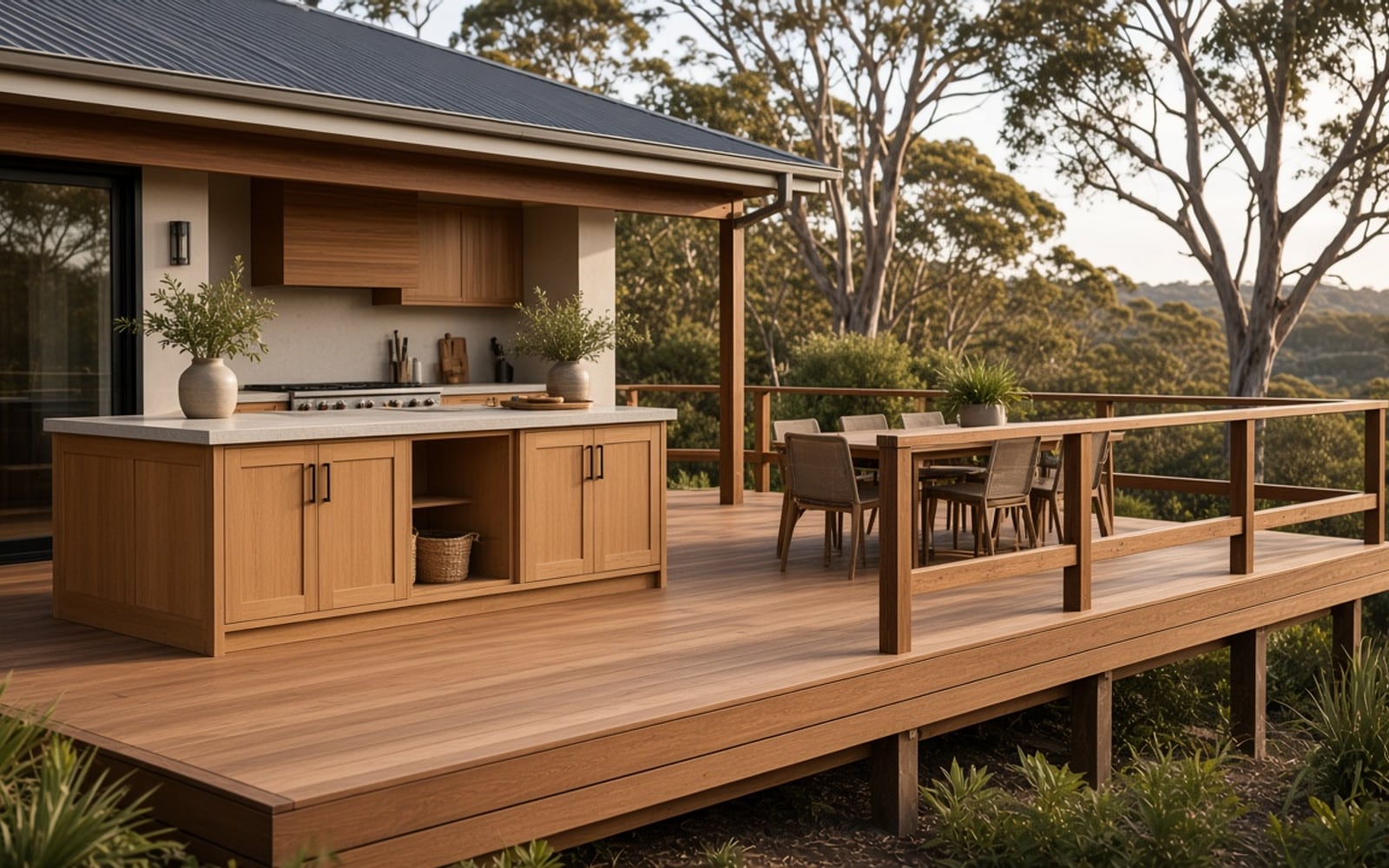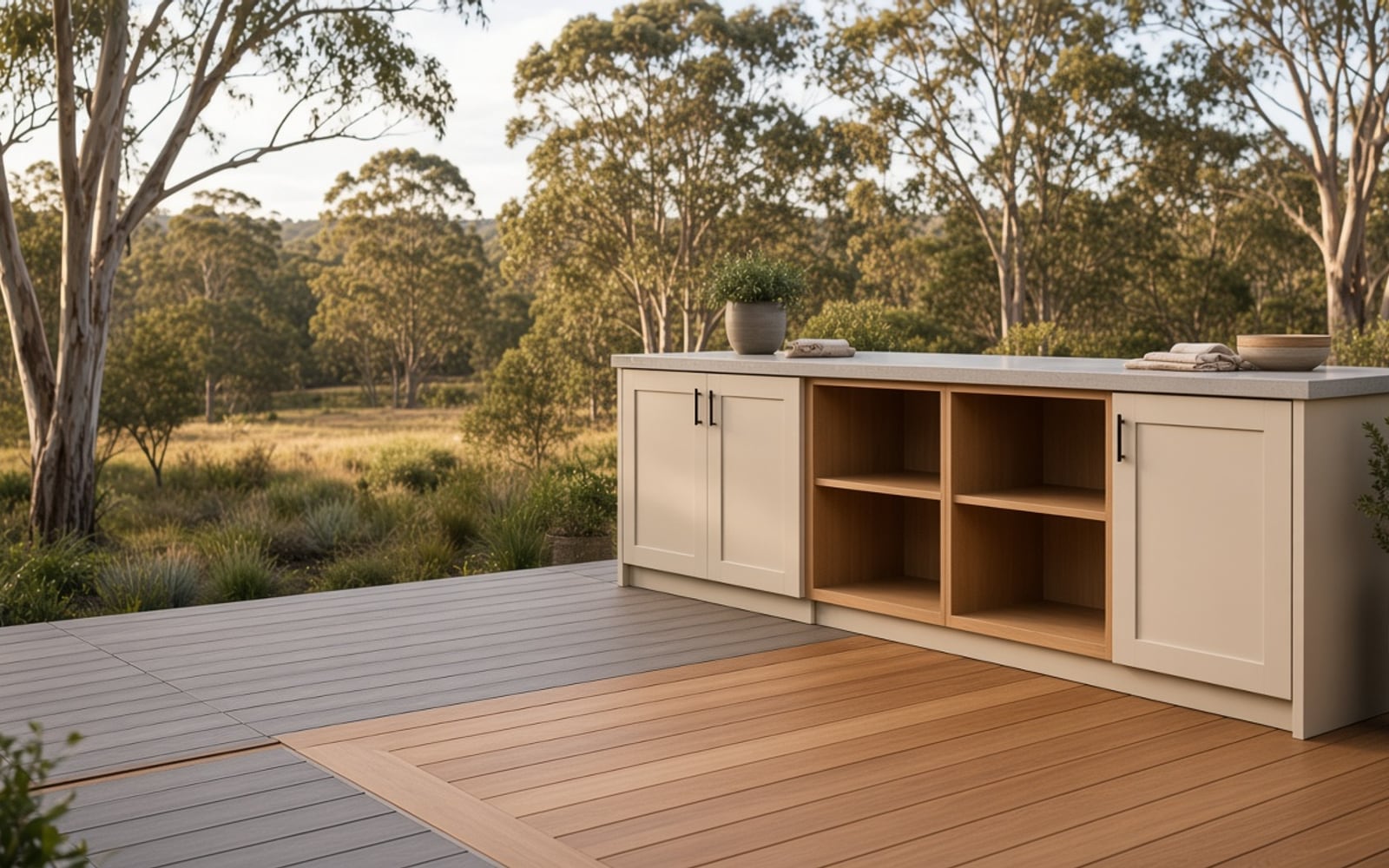
On the Central Coast, a deck lives a hard life. Salt air in Terrigal, humidity around Brisbane Water, hot afternoon sun and bushfire zones in the hinterland all push materials to their limits. This guide compares composite decking Central Coast homeowners are considering with traditional hardwood, covering cost, maintenance, bushfire ratings and heat.
SteepWood is a Newcastle carpentry and joinery business that builds decks and outdoor carpentry, and we travel to the Central Coast regularly for measures and installs.
Cost: composite vs timber
| Deck material | Indicative NSW cost (built) | Source note |
|---|---|---|
| Timber deck | $250–$500 per m² | Treated pine at the low end, hardwood higher |
| Composite deck | $350–$700 per m² | Brand, board profile and fixings drive price |
| Composite installation labour | $200–$400 per m² | Premium systems $300–$450 |
| Re-oiling a timber deck | $15–$35 per m² | Repeated regularly over the deck's life |
Other national estimates put composite at about $350–$550 per m², with hardwood around $280–$420. The ranges overlap because quality and site conditions vary so much. These are indicative 2026 planning figures, not a SteepWood quote. For a Hunter comparison, see our Newcastle decking cost guide.
Maintenance over ten years
The real comparison is not day one, it is year ten.
| Factor | Hardwood timber | Capped composite |
|---|---|---|
| Cleaning | Wash and scrub | Wash |
| Oiling | Regular re-coats to keep colour | Not needed |
| Greying | Turns silver grey if left uncoated | Colour holds, some fading |
| Repairs | Sand and re-oil scratches | Replace damaged boards |
| Splinters | Possible as boards age | None |
| Mould near water | Can occur on shaded decks | Can occur, but easier to clean |
On a 30 square metre deck, each oiling at NSW rates adds up quickly over a decade. For busy households or holiday homes in Pearl Beach or Avoca, composite often wins on time.
Bushfire ratings on the Central Coast
Much of the Coast is bushfire-prone land, and the Central Coast Council bushfire-prone land map is the starting point for any deck near bushland.
- Hardwoods such as Blackbutt, Merbau, Spotted Gum, Silvertop Ash and Turpentine are listed as bushfire-resisting timbers for use up to BAL-29.
- Some composite products are tested and rated from about BAL-12.5 up to BAL-40, but many are not rated at all.
- Exempt decks on bushfire-prone land within 5 metres of a house must use non-combustible materials.
Always confirm the BAL rating for your property before choosing boards.
STEEPWOOD DECKS — Timber and composite decks for Central Coast homes, built by a licensed carpentry business with the right fixings for salt air and the right materials for your BAL rating. Get a free measure and quote or contact the workshop.
Heat, glare and comfort
Dark boards can get hot in full sun. On north- and west-facing decks in Kincumber, Erina or Wyong, a light grey or light timber-tone composite, or a pale hardwood like Blackbutt, is more comfortable for bare feet. Shade sails, a pergola or a roof over part of the deck also help.
Coastal design details that matter
| Area | Condition | Specification |
|---|---|---|
| Terrigal, Avoca, Copacabana | Salt spray and wind | 316 stainless fixings, ventilated frame |
| Woy Woy and Ettalong | Low-lying, humid | Good ground clearance and drainage |
| Gosford and Point Frederick | Waterfront humidity | Durable subframe, sealed board ends |
| Wyong and Tuggerah | Hot summers | Light board colours, shade structure |
| Hinterland (Somersby, Matcham) | Bushfire-prone | BAL assessment and rated materials |
Our Central Coast service area page lists the suburbs we visit.
Subframes: the hidden part of every deck
Whichever board you choose, the subframe decides how long the deck lasts. Treated pine or hardwood joists, or steel subframes, must be sized and spaced to the board maker's rules. Composite boards often need closer joist spacing than hardwood. Good ventilation underneath is essential, especially on low decks near the ground.
Approvals for Central Coast decks
Many small backyard decks are exempt. Under NSW rules a deck can be exempt if it is no more than 25 square metres, no more than 1 metre above ground and at least 900 mm from the boundary in most zones. Larger, higher or waterfront decks usually need approval.
Who builds your deck
In NSW, carpentry work includes timber and timber composites and footings for timber decks. SteepWood is Pavit Pty Ltd trading as SteepWood, ABN 52 697 313 269, NSW Carpentry Contractor Licence 489553C, with $20 million public liability. Our Central Coast joinery cost guide covers indoor work in the same area, and our timber species guide compares local hardwoods.
Which one should you choose
There is no single right answer, but the pattern is clear after many Central Coast measures.
Choose hardwood timber if:
- You love natural grain and are happy to oil the deck every year or two.
- The deck is partly shaded or under a roof, so weathering is slower.
- Your BAL rating suits a listed bushfire-resisting species.
- You want the option to sand and refresh the surface later.
Choose composite if:
- The deck is a holiday home or rental and nobody wants to maintain it.
- The site is exposed to salt spray, sun and rain all year.
- You want a consistent colour that will not grey.
- Children or pets play on the deck and splinters are a worry.
Many clients choose a mix: hardwood stairs and fascia with composite boards, or composite on the open area with hardwood under the roof. We can price both options side by side so you can compare.
Related guides in this series
Frequently asked questions
Is composite decking more expensive than timber?
Usually yes upfront. NSW timber decks are commonly quoted around $250 to $500 per square metre built and composite decks around $350 to $700 per square metre. Composite avoids regular oiling, so the gap narrows over time. These are indicative 2026 ranges, not a quote.
Is composite decking good near the beach?
Quality capped composite handles salt air and moisture well and does not need oiling. The subframe and fixings matter as much as the boards, so use stainless steel fixings and a well-ventilated frame near the coast.
Can I use composite decking in a bushfire zone?
Only some composite products have bushfire test evidence, with ratings ranging from about BAL-12.5 to BAL-40 depending on the product. Your BAL rating must be confirmed first, then a product with matching evidence chosen. Several hardwoods such as Spotted Gum and Blackbutt are listed as bushfire-resisting up to BAL-29.
Does composite decking get hot?
Darker composite boards can get noticeably hot in full summer sun. Choose a lighter colour for north- or west-facing decks, or add shade. Light-coloured hardwoods also stay cooler than dark boards.
How long does composite decking last?
Quality capped composite boards often carry long manufacturer warranties, commonly 20 years or more for the boards. Check exactly what the warranty covers, such as fading and staining, and follow the installation rules for the warranty to apply.
Get your Central Coast deck priced
Send photos, rough sizes and whether you lean towards timber or composite. We will check BAL and approval issues and give you an itemised price for both options. Get a free measure and quote or call 0468 387 676.