Compact laminate joinery has become the go-to choice for commercial areas that get wet, hit or cleaned hard every day. Staff kitchens, clinic wet zones, barber stations, change rooms and cafe counters all benefit from a material that does not swell, chip at the edge or need edge tape. This guide explains what compact laminate is, where it works, how thick it should be and when standard laminate is still the better value.
SteepWood machines and installs compact laminate in our Newcastle workshop for commercial clients across Newcastle, the Central Coast and Sydney.
What compact laminate is
Compact laminate, also called compact high-pressure laminate or CHPL, is a solid structural panel rather than a surface finish. Many layers of resin-impregnated kraft paper are pressed under high heat and pressure into a dense panel with a decorative face on one or both sides.
Standard laminate is a thin decorative sheet glued to particleboard or MDF. If water gets past the edge, the core swells. Compact laminate has no core to swell.
Compact laminate vs standard laminate
| Feature | Compact laminate | Standard laminate on board |
|---|---|---|
| Core | Solid laminate | Particleboard or MDF |
| Water resistance | Excellent, non-porous | Good until edges are breached |
| Edges | Machined, no edge tape | Edge tape needed |
| Strength | Self-supporting | Relies on substrate |
| Weight | Heavy | Lighter |
| Cost | Higher | Lower |
| Tooling | Carbide tools, specific hardware | Standard joinery tooling |
Remica's guide notes that compact laminate suits sink cut-outs, exposed edges, frequent wet cleaning and high humidity, while joints, fixings and installation still affect how well the finished system performs.
Common thicknesses
| Thickness | Typical uses |
|---|---|
| 6–8 mm | Wall linings, splashbacks, thin panels |
| 12–13 mm | Partitions, vanity tops, benchtops on cabinets, lockers |
| 18 mm and above | Heavy-duty worktops, laboratory benches, exposed structural edges |
Duracube describes 13 mm as the Australian commercial standard for most amenity work. Laminex stocks 13 mm and 18 mm multipurpose compact laminate in 3660 by 1830 mm sheets.
Where compact laminate beats standard laminate
- Staff kitchen benchtops around sinks and dishwashers. See our office kitchenette guide.
- Medical and dental wet zones, handwash bays and clean utility rooms. See our medical fitout guide.
- Barber and salon stations and colour bars. Laminex lists its XR grade as a good choice for hair salons. See our barber shop fitout guide.
- Change rooms, lockers and benches in gyms, schools and workplaces.
- Cafe counters and servery tops that are wiped all day.
- Alfresco and outdoor kitchens, using exterior-grade compact laminate.
STEEPWOOD COMMERCIAL JOINERY — Compact laminate benchtops, lockers and wet-zone joinery machined in our Newcastle workshop for offices, clinics, salons and cafes. Explore commercial joinery or Get a free measure and quote.
When standard laminate is enough
Compact laminate is not needed everywhere. Standard laminate on moisture-resistant board is good value for:
- Office storage, filing and overhead cabinets.
- Reception counter bodies away from water.
- Shelving and retail display.
- Cabinet carcasses under a compact laminate top.
A common, cost-effective approach is to use compact laminate only for tops and wet zones, with standard laminate or 2-pac for doors and carcasses. Our finishes guide compares those finishes.
Design details that matter
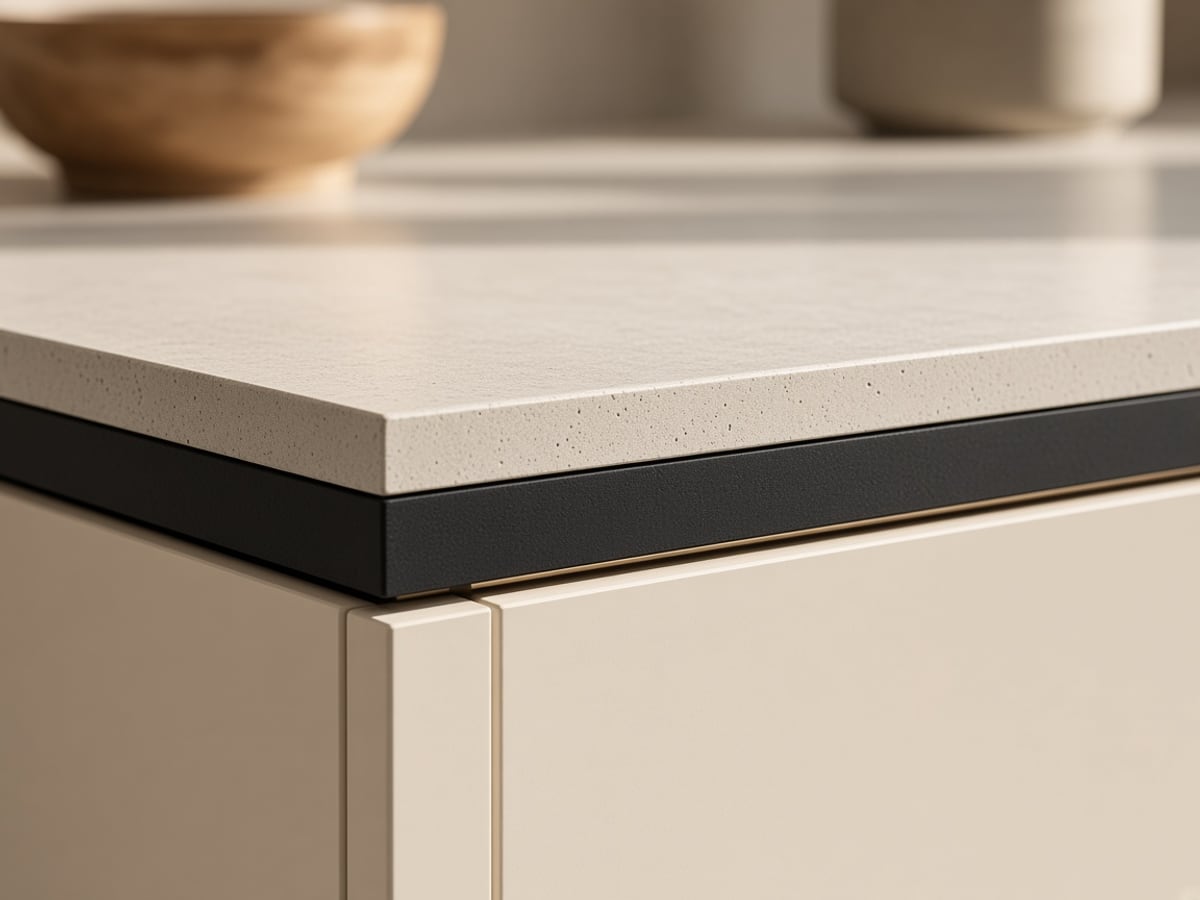
- Dark or coloured core edge: Many ranges have a black, grey or white core that shows on the edge, which suits a slim modern look.
- Sink cut-outs: Undermount sinks work well because the edge is solid and machined.
- Support: Benchtops need enough support from cabinets or brackets to avoid sag over long spans.
- Fixings: Use hardware designed for compact laminate, not standard particleboard screws.
- Joins: Plan joins away from sinks where possible.
Brochures such as the polytec compact laminate guide also note that compact panels in sliding or hinged uses may need a stabilising system.
Cost considerations
Compact laminate carries a higher upfront cost than standard laminate sheets, and machining takes more time and tooling. On a typical commercial job, the cost difference is concentrated in the tops and wet zones. In a busy staff kitchen or clinic, replacing a swollen laminate benchtop after a few years usually costs more than doing it in compact laminate first.
| Item | Where the money goes |
|---|---|
| Material | Higher sheet cost than board-based laminate |
| Machining | Carbide tooling, slower cutting |
| Hardware | Specific fixings and brackets |
| Install | Heavy panels, two-person lifts |
| Long-term | Fewer replacements in wet areas |
Regions we supply
We machine compact laminate in Newcastle and install across the Hunter, Central Coast and Sydney. See Newcastle commercial joinery and our Newcastle commercial joinery guide for local projects. Childcare centres are a common use, covered in our childcare centre joinery NSW guide.
SteepWood is Pavit Pty Ltd trading as SteepWood, ABN 52 697 313 269, NSW Carpentry Contractor Licence 489553C, with $20 million public liability and a 10-year structural warranty on joinery.
Frequently asked questions
What is compact laminate?
Compact laminate is a solid high-pressure laminate panel made from many layers of resin-impregnated paper pressed together. It has no particleboard or MDF core, so it is self-supporting and does not swell when wet.
Is compact laminate waterproof?
The panel itself is solid and non-porous, so it does not absorb water like board-based products. Joints, fixings and installation still affect how a finished system performs in wet areas.
What thickness of compact laminate should I use?
13 mm is the common Australian thickness for partitions, vanity tops and benchtops on supported cabinets. Thicker panels, 18 mm and above, suit heavy-duty worktops and laboratory benches.
Is compact laminate more expensive than normal laminate?
Yes. Compact laminate costs more than standard laminate on a board substrate, and it needs carbide tooling and specific hardware. For wet and high-use areas, its longer life often offsets the higher upfront cost.
Can compact laminate be used for kitchen benchtops?
Yes. It is popular for staff kitchens, cafes and some homes because it resists water, heat and stains and allows a slim, modern edge. Accurate fabrication and support are important.
Specify compact laminate for your project
Send us your plans or a list of the areas that get wet or heavy use. We will recommend where compact laminate is worth it, where standard laminate is enough and price both options. Get a free measure and quote or call 0468 387 676.